Your immigration journey often succeeds or fails based on a single document: your birth certificate translation, for example. One formatting error, one missing stamp, one incomplete certification statement—and USCIS sends back a Request for Evidence (RFE) that delays your case by months.
The stakes are higher than ever. With processing backlogs at record levels and USCIS scrutiny intensifying, getting your USCIS translations right the first time is essential to avoiding costly delays.
At JR Language Translation Services, we understand what’s at stake. We’ve helped thousands of applicants submit USCIS-compliant documents that pass review without complications. This guide reveals exactly what USCIS requires, why professional translation services matter, and how to ensure your immigration document translations meet every standard.
USCIS Requirements: What You Absolutely Must Include
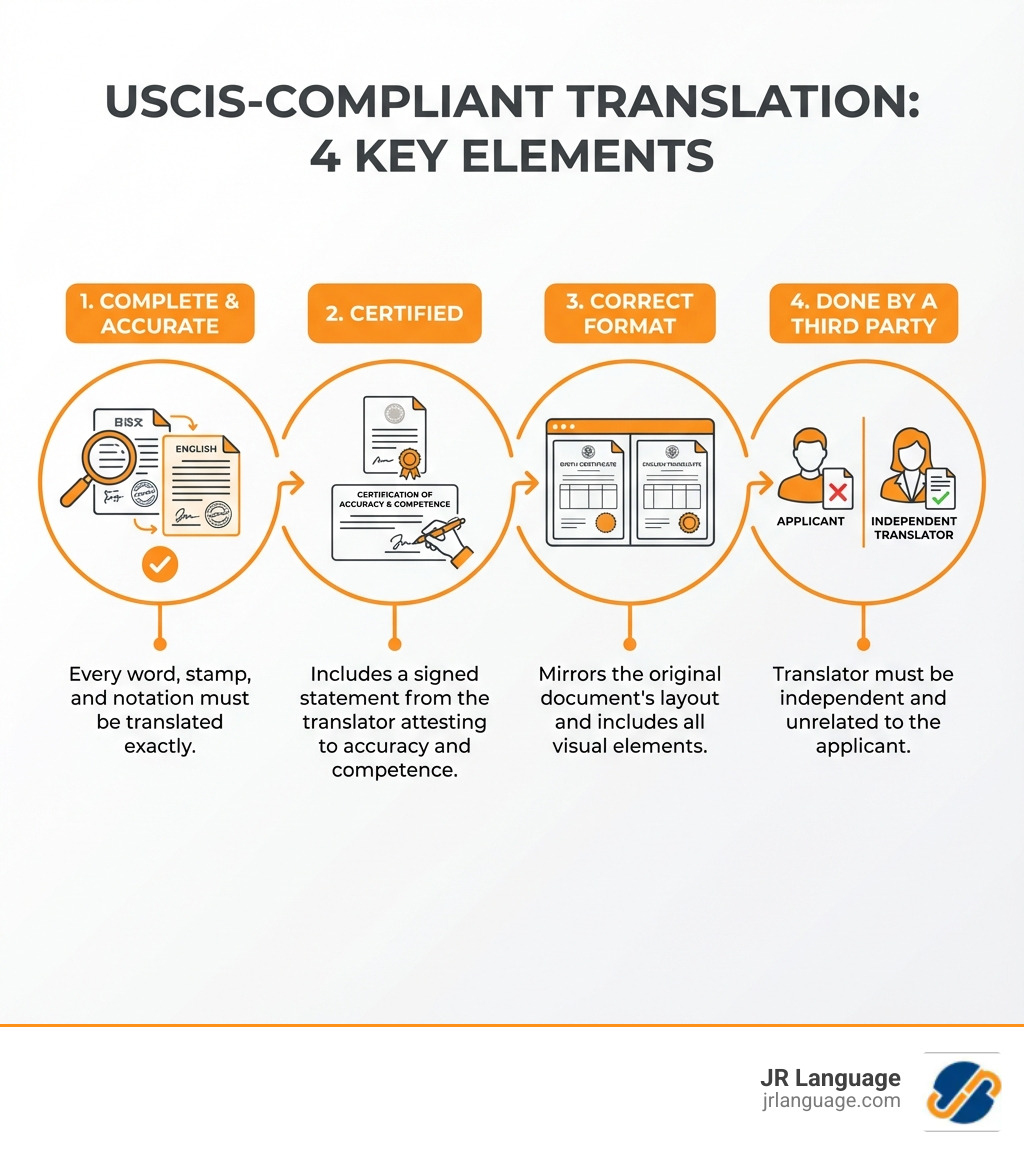
USCIS follows strict rules for document translations. Missing a detail can trigger delays or Requests for Evidence (RFEs). Here’s what your translation must have:
- Complete translation: Every word, date, stamp, seal, and handwritten note must be included. Nothing can be skipped.
- Certification statement: A signed declaration from a professional translator confirming the certified translation is accurate and complete.
- Mirrored layout: The English translation should replicate the original certificate’s structure for easy comparison.
- Independent translator: You can’t translate your own documents. USCIS requires an impartial third party.
We ensure every birth certificate translation meets all these requirements so your documents are ready for submission without revisions.
When You’ll Need a Translated Birth Certificate
Your birth certificate verifies your identity for almost every U.S. immigration application. This includes:
- Green card applications (I-485) – Required for adjustment of status
- Citizenship (N-400) – Needed for naturalization
- Family petitions – To sponsor relatives
- Consular processing – Immigrant visas at embassies
- Fiancé(e) visas (K-1) – Both petitioner and beneficiary need certified translations
- Employment visas – Many work authorizations require civil identity documents
- Asylum or refugee cases – Birth records confirm identity and family relationships
Our team specializes in translations for all these scenarios, ensuring USCIS compliance every time.
Understanding Certified Translation for USCIS
USCIS requires “certified translation”—but what does that actually mean?
It’s not about special licenses or government registration. It’s about a signed statement from a competent translator confirming:
- The translation is accurate and complete
- The translator is fluent in both source and target languages
- The translator’s full name, signature, date, and contact information
That certification statement transforms a translation into a document USCIS accepts. Without it, even a perfect translation gets rejected.
At our immigration translation agency, our native-speaking translators specialize in immigration documents. We understand both linguistic nuances and USCIS compliance requirements, ensuring every translation includes proper certification that satisfies immigration authorities.
No Notarization Required
Despite widespread confusion, USCIS does not require notarized translations. The translator’s certification statement is sufficient. Some agencies or embassies may request notarization for their own purposes, but for USCIS submissions, a proper certified translation without notarization meets all requirements.
Why Self-Translation Creates Serious Risks
USCIS technically permits “any person competent in both languages” to translate documents. In practice, self-translations or family translations invite problems:
- Credibility Concerns: Immigration officers expect independent and impartial translations. When you translate your own birth certificate—the document proving your eligibility for an immigration benefit—officers question objectivity.
- Technical Errors: Birth certificates contain specialized terminology, official stamps, and formatting conventions. Without translation expertise, errors slip through—errors that trigger RFEs or contribute to denials.
- Incomplete Certification: DIY certification statements frequently omit required elements or employ incorrect language, thereby failing to meet USCIS standards.
- Heightened Scrutiny: Self-translations draw extra attention from adjudicators already managing enormous caseloads. Why invite additional review when professional translation services eliminate the risk?
- Application Delays: Rejected translations require resubmission, adding months to already lengthy processing times. With USCIS facing record backlogs, avoiding delays protects your immigration timeline.
Professional USCIS translation services provide the credibility, accuracy, and proper certification that self-translations cannot match.
The Critical Importance of Formatting and Presentation
USCIS officers review thousands of documents. They need immediate visual confirmation that your translation matches the original. This requires:
- Layout Mirroring: Tables, text boxes, official seals, and signatures should be positioned in the same locations as in the original document. When officers can quickly compare elements side by side, the review proceeds smoothly.
- Complete Visual Element Translation: Every stamp, seal, handwritten note, and marginal annotation must be translated and positioned appropriately. If it’s visible on the original, it belongs in the translation.
- Legible Submission Format: Submit clear photocopies of both the original birth certificate and certified translation. Never submit your only original—keep it safe for interviews or future needs.
Our USCIS translators format every translation to mirror the source document exactly, making USCIS review efficient and reducing the risk of questions or delays.
When the Original Birth Certificate Isn’t Available
If you cannot obtain your original birth certificate, USCIS accepts alternative documentation:
- Letter of Non-Availability: Official statement from the vital records authority in your birth country confirming the certificate doesn’t exist or cannot be issued.
- Secondary Evidence: Baptismal certificates (issued shortly after birth), hospital birth records, early school records, or census documents containing birth information.
- Affidavits: Sworn statements from family members or others with direct knowledge of your birth, providing details about date, location, and parentage.
All alternative documents in foreign languages require certified translation. Professional translators handle translations for letters of non-availability, affidavits, and secondary evidence, ensuring that even complex situations meet USCIS standards.
Common Questions About Birth Certificate Translation for USCIS
Must I submit the original translated document?
No. USCIS accepts clear photocopies of both the foreign-language birth certificate and the certified translation. Retain originals for interviews or future applications.
What happens if my translation contains errors?
Errors can trigger RFEs, adding months to processing times, or contribute to application denials. Professional translators prevent these risks through quality assurance processes and expertise in immigration document requirements.
Can I use free online translation tools?
Never. Automated translation lacks the required certification statement, cannot replicate formatting, produces linguistic errors, and fails USCIS compliance standards. Officers reject these translations immediately.
How long does a certified translation remain valid?
Indefinitely. One properly certified translation can be used for multiple applications throughout your immigration journey, making professional translation services a lasting investment.
What about handwritten notations on my birth certificate?
Everything visible must be translated. Illegible handwriting is noted in the translation (e.g., “Handwritten notation illegible”), ensuring complete documentation without speculation.
| Factor | DIY/Family Translation | JR Language Translation Services |
|---|---|---|
| USCIS Compliance | High rejection risk | Guaranteed standards |
| Accuracy | Error-prone | Native speaker precision |
| Certification | Often incomplete | Proper and complete |
| Impartiality | Questioned | Independent credibility |
| Outcome | Delays or denials | Smooth process |
Let Our Professional Translators Protect Your Immigration Journey
Immigration applications carry life-changing consequences. Rejected translations delay reunification with family, postpone employment opportunities, and jeopardize your immigration status. The difference between smooth approval and frustrating delays often comes down to document quality.
We eliminate translation risks through:
- Guaranteed USCIS Compliance: Every translation meets all official requirements—complete text, proper certification, accurate formatting.
- Native-Speaker Expertise: Our translators are fluent in both languages and experienced with civil documents, ensuring linguistic accuracy and cultural competency.
- Specialized Immigration Knowledge: We understand USCIS standards, common rejection reasons, and how to prevent them.
- Multi-Tier Quality Assurance: Independent review catches errors before they reach USCIS, protecting your application.
- Secure Document Handling: Your sensitive personal information remains confidential through secure transmission and strict privacy protocols.
- Professional Formatting: Translations mirror original documents, making USCIS review straightforward and efficient.
Whether you’re applying for adjustment of status, naturalization, family reunification, or any other immigration benefit, your birth certificate translation must be perfect. With USCIS processing over 800,000 naturalizations and more than a million green card applications annually, the immigration system demands precision.
Don’t risk your immigration dreams on inadequate translations. JR Language Translation Services provides certified translation services that meet USCIS standards and protect your application from preventable delays.