

Under U.S. product liability law, “failure to warn” is one of the three primary grounds on which manufacturers face legal exposure — alongside design defects and manufacturing defects. It covers situations where a product caused harm not because it was built incorrectly, but because the instructions, warnings, or documentation failed to adequately inform the user.
In international markets, where product manuals routinely cross language boundaries, failure-to-warn claims frequently trace back not to what the original documentation said, but to what the translated version failed to convey — a softened warning, an ambiguous instruction, a mistranslated unit of measurement.
The product worked exactly as designed. The manual didn’t. The failure was in not partnering with a skilled translation service provider who understood the technical nuances.
The Case for Professional Technical Manual Translations
This is the stakes environment in which professional technical manual translation services operate. It’s not a communications task dressed up in technical vocabulary. It’s a risk-control function with direct implications for user safety, regulatory compliance, product liability, and brand trust.
For any organization distributing technical products in international markets — machinery, medical devices, industrial equipment, aerospace components, software systems — the quality of the translated manual is as consequential as the quality of the product it documents.
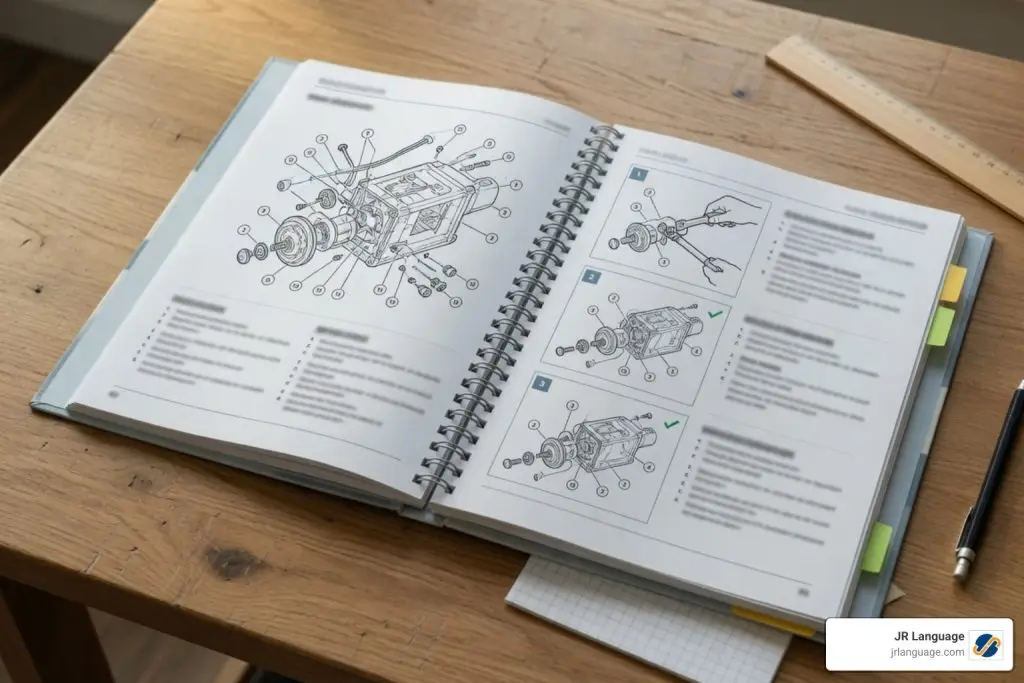
Simplified Technical English: The Standard for Highly Regulated Manuals
The quality of a technical manual translation is directly shaped by the quality of the source document. There is an international standard specifically designed to make technical documentation both easier to understand and significantly cheaper and more accurate to translate.
It’s called Simplified Technical English, or ASD-STE100. It was developed in the late 1970s by the European Association of Aerospace Industries at the request of European airlines, which needed aircraft maintenance documentation that non-native English speakers could understand safely. Procedural sentences are limited to 20 words, and descriptive sentences are communicated within 25 sentences, for example, within this standard, leading to a better understanding of the same procedure across multilingual speakers.
Highly regulated manuals, such as the maintenance manuals that aerospace translation services regularly deal with, comply with these standards.
How Does This Apply to Your Business Manual?
You may not be in a highly regulated industry yourself. However, when seeking to translate the user manuals for your business, whether for your clients or your workforce, make sure your original source text is in a simplified language. This will ensure the translated document – whether done through an expert human translator or with an AI-powered translation service, raw or hybrid – is rendered accurately and remains accessible to your target base.
Consult with a reputed language solutions provider such as JR Language Translation Services. We have the technical expertise to meet your industry’s regulatory requirements, as well as the linguistic skills. We also have years of extensive experience working in multiple industries and in over 100 languages.
The Professional Workflow for Technical Manual Translation Services
A professional technical translation services workflow looks meaningfully different from a standard document translation process.
Here are the key stages and what each involves:
Terminology management before translation begins:
- Development of a project-specific glossary of approved technical terms, part names, and acronyms in both source and target languages
- Review and approval of the glossary by the client’s subject-matter experts before translation starts
- Integration of the glossary into the translation environment so that approved terms are flagged when they appear
Subject-matter matched translation:
- Assignment to translators with verified domain expertise — not general technical translators, but specialists in the relevant field
- Native speakers of the target language who write with the fluency of original authorship, not the pattern of someone converting from another language
- Working in the native file format (XML, FrameMaker, InDesign, DITA, and others) to preserve layout, embedded text in diagrams, and document structure
Multi-stage quality assurance:
- Independent bilingual editing against the source document — a second qualified linguist checks accuracy, completeness, and terminology consistency
- Subject-matter expert (SME) review for safety-critical or highly regulated content
- Desktop publishing (DTP) review to verify that translated text fits the layout correctly and that all diagram labels, callout bubbles, and numbered steps are properly aligned
Translation memory management:
- All translated segments stored in a translation memory database
- When the manual is updated, only new or revised segments require fresh translation — significantly reducing cost and turnaround time for subsequent versions
- Consistency is automatically maintained across document versions and across a family of related products
Where Technical Manual Translation Risk Is Highest
Not all sections of a technical manual carry equal risk. Not following a well-documented and thoroughly reviewed manufacturing translation service guide, for example, can lead to incorrect machine operation, causing costly compliance failures and compromising workers’ safety.
Professional translation services for manufacturing and other technical manuals prioritize these content types for the most rigorous review:
- Safety warnings and cautions — the distinction between DANGER, WARNING, and CAUTION is defined by ANSI and ISO standards and must be rendered with the same hierarchical precision in every target language; softening a mandatory warning to a suggestion is a liability exposure
- Procedural steps — numbered sequences where missing, reordered, or ambiguous steps can lead directly to equipment damage or user injury
- Unit conversions — torque values, pressure ratings, temperature thresholds, electrical specifications; these must be converted accurately for the target market’s measurement system, not simply carried over from the source
- Part numbers and nomenclature — must be identical to those used in the corresponding parts catalog and ordering system in the target market
- Regulatory compliance statements — conformity declarations, CE marking language, and FDA compliance statements; these carry legal force and must meet the exact formulation required by the receiving authority
Technical Manual Translation Services That Match the Precision of the Work
At JR Language Translation Services, our technical translation services team includes native-speaking professionals with industry-specific expertise across aerospace, manufacturing, medical devices, engineering, and software documentation. Every technical manual project is supported by dedicated terminology management, subject-matter matched translators, multi-stage quality assurance, and DTP capability for final layout verification.
Whether you are translating a maintenance manual for international distribution, localizing an IFU for EU MDR compliance, or managing ongoing documentation updates across a multilingual product line, we deliver with the accuracy, consistency, and regulatory awareness that technical content demands.
Contact JR Language to discuss your technical manual translation project and receive a clear, no-obligation estimate.


