

In the global aerospace sector, there is a clear picture of new emerging and transitioning markets: China, Southeast Asia, South Asia, the Middle East, Latin America, and Africa. These regions are projected to account for 55% of all new commercial aircraft deliveries over the next two decades.
These are the markets where US aerospace companies are forging new partnerships, establishing MRO operations, and training multilingual technical workforces. Implementing multilingual documentation that works in languages beyond English is more crucial than ever, making a partnership with a trusted language translation partner an important step in your aviation expansion.
Multilingual Documentation in Aviation: The Practical Question
For operations leaders at US aerospace companies, that growth picture raises a practical question: Is your multilingual documentation strategy ready to keep pace? Professional aerospace translation services are the way companies bridge the gap between where they build and where they operate.
Building that capability takes a lot more planning than most teams have anticipated. This guide walks through what that planning looks like, from scope to execution.

Aerospace vs Aviation Translation: The Key Distinction
Before you even start building a multilingual communication database, it helps to know exactly what it is you’re translating: Aerospace translation and aviation translation can serve two distinct functions, involve different document types, and often require different language expertise.
Aerospace Translation Services: Highly Technical Documentation
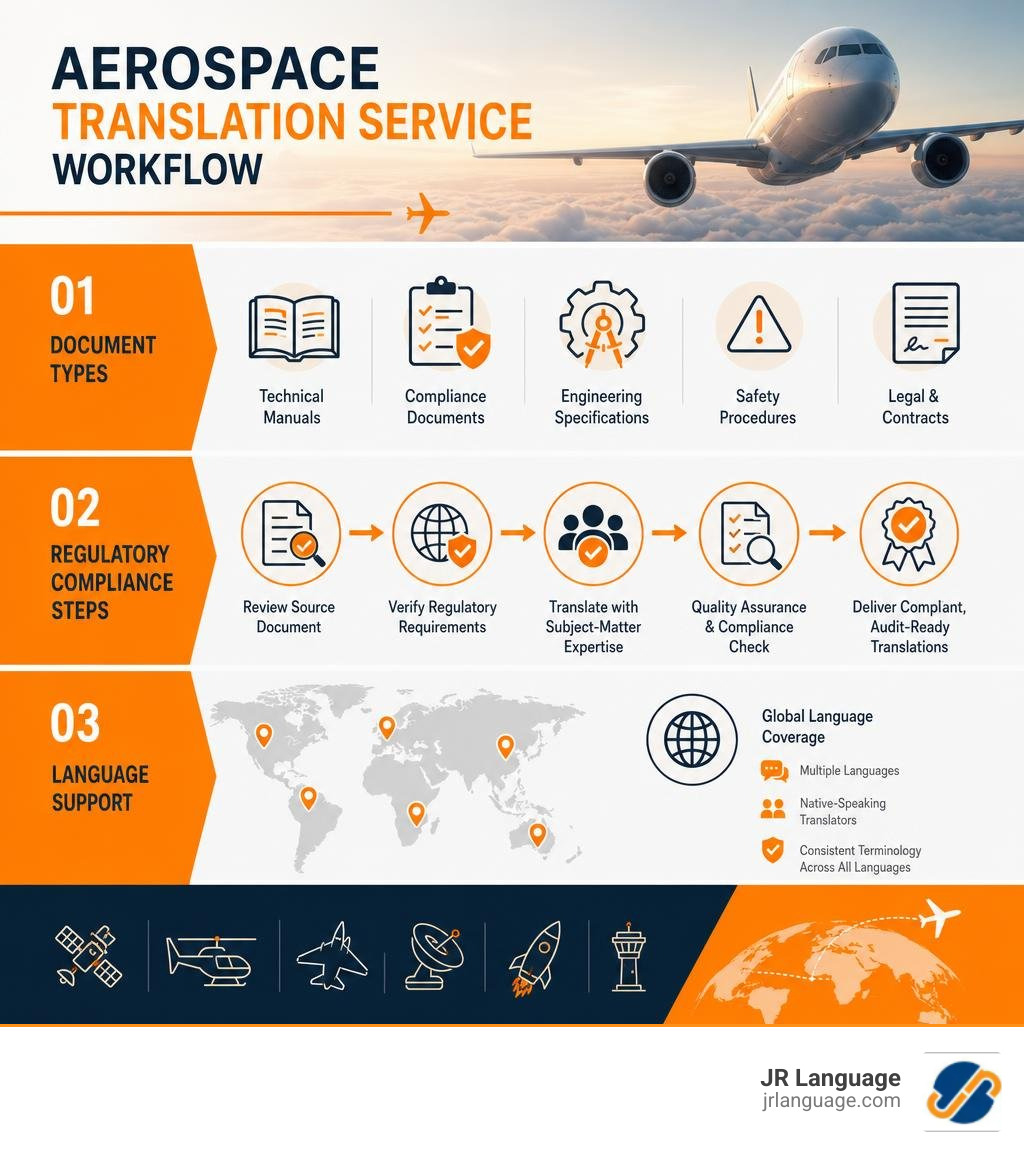
Aerospace translation refers to the engineering, manufacturing, defense, and space segments of the industry. The content involves highly technical translation services. These are often proprietary and subject to export control regulations, such as the International Traffic in Arms Regulations (ITAR). This includes:
- Engineering specifications and CAD documentation
- Maintenance manuals for components and illustrated parts catalogs
- Airworthiness directives and certification filings
- Defense contracts and procurement documentation
- Patent translations – applications and IP filings
- Research and development documentation
Aviation Translation Services: Operational and Safety Protocols
Aviation translation covers the commercial airline and operational side – the content that keeps aircraft flying safely and passengers informed. Document translation services for this sector include:
- Flight operations manuals and crew procedures
- MRO training materials and safety manuals
- Passenger-facing content: safety cards, in-flight materials, and booking platforms
- Air traffic control communications and ground operations documentation
- Airport signs, wayfinding, and customer service materials
Why Invest in Both Services?
The distinction matters in operations because these two categories often involve different teams, regulatory frameworks, and translation requirements. For example:
- A maintenance technician manual for an MRO facility in Southeast Asia needs a translator with experience in aviation maintenance and familiarity with local regulatory language.
- A patent filing for a propulsion system entering a Chinese joint venture requires a translator with aerospace engineering expertise and fluency in IP law.
Treating them as the same is where documentation strategies start to fall apart.
What a Multilingual Documentation Strategy Requires
When operations leaders start planning for international expansion, overcoming language barriers with aerospace translation is often treated as an afterthought – something to sort out once the markets, partnerships, and timelines are confirmed. In reality, building documentation capability that communicates with diverse groups is an infrastructure decision that needs to happen earlier in the process.
Here’s what a mature aerospace multilingual translation strategy actually covers:
Terminology Management
Every aerospace organization has its own vocabulary:
- part names
- system designations
- process terms
- acronyms that carry specific meaning within your documentation ecosystem
Before translation even begins, that vocabulary needs to be captured in a project-specific glossary, reviewed by your subject-matter experts, and locked in as the approved reference for every target language.
Without this step, the same component gets translated three different ways across three documents. This adversely affects consistency, which is both a safety requirement and a regulatory expectation.
File Format and Technical Integration
Aerospace documentation doesn’t live in Word documents. It lives in XML schemas, DITA architectures, FrameMaker files, S1000D data modules, and CAD-linked documentation systems. A translation partner that can’t work natively in these formats creates a conversion problem that adds time, cost, and risk to every project.
For operations teams managing large documentation libraries, multilingual desktop publishing capability across multiple formats is non-negotiable.
Regulatory Alignment by Market
Each market you enter has its own regulatory language expectations:
- FAA documentation has specific formatting and terminology requirements
- EASA compliance documentation has its own conventions.
- Aviation authorities in Japan, China, Brazil, and the UAE each have their own documentation standards
Your translated materials need to meet these standards, not just linguistically, but structurally. The JR Language translators understand the regulatory context of each target market, not just the target language.
Translation Memory and Version Control
Aerospace documentation is never static:
- Technical manuals get revised
- Airworthiness directives get updated
- Safety procedures change
A translation memory system stores every approved translation segment so that when documentation is updated, only the changed sections require fresh translation. This preserves consistency, reduces cost, and significantly cuts turnaround time for subsequent versions.
For operations teams managing ongoing documentation across a family of related products, this is where the efficiency gains compound over time.
JR Language: The Right Translation Partnership for Aerospace Operations
The operational demands of aerospace translation for multilingual communication include technical precision, regulatory awareness, terminology consistency, and adherence to security protocols. This makes provider selection a more critical decision than in most other industries.
For operations leaders evaluating options, these are the factors that make JR Language translation partnership work at scale:
- Subject-matter matched translators: We work with native-speaking professionals with aviation domain expertise. The technical translator working on your MRO manual will understand the engineering context, not just the words.
- Regulatory compliance: For any defense-related or controlled technology documentation, your translation partner needs to be able to operate within the relevant regulatory-compliant protocols.
- Scalability across languages and volume: Entering multiple markets at the same time means translating the same documentation into several languages at the same time. We work with over 100 language pairs, and we have technology tools such as AI translation services, both raw and hybrid, to translate large volumes of content.
- Security standards: Aerospace documentation often contains proprietary engineering data, competitive intelligence, and sensitive defense information. We offer encrypted file transfer, access controls, and NDA coverage as needed.
- Quick turnaround for time-sensitive documentation: Certification timelines, regulatory filing deadlines, and market entry schedules don’t bend around translation backlogs. Our team of capable project managers efficiently manages workflows to deliver on time without sacrificing accuracy or quality standards.
Work With Us: Aerospace Translation Services Built for Operations
At JR Language Translation Services, we work with US aerospace and aviation companies who are managing the documentation demands of international expansion – from engineering specifications and compliance filings to MRO training materials and multilingual workforce communications.
Our aerospace translators bring native-language fluency coupled with industry expertise in aviation maintenance, aerospace engineering, defense, and regulatory compliance. Every project gets dedicated terminology management, subject-matter-matched translation, multi-stage quality assurance, and the technical know-how to work with the file formats that aerospace documentation lives in.
Reach Out to Us Today!
Preparing documentation for a new market entry? Localizing training materials for a multilingual MRO workforce? Managing ongoing translation across a global product line?
JR Language delivers the accuracy, consistency, and regulatory awareness that aerospace operations demand. Get a free quote today!


