

Need your industrial machinery to legally enter an EU member state’s market? You must provide complete documentation in that country’s official language.
Think installation instructions, safety information, and technical specifications. With 24 official EU languages, that’s not a footnote in the compliance checklist.
It’s a market entry requirement that shapes the entire documentation strategy for any manufacturer with European ambitions. For businesses operating across borders, professional translation services have become a production requirement.
Professional Translators are Integral to Manufacturing Regulations
Does your industrial product clear customs on schedule? Routinely pass regulatory audits? Scale into new markets without delays?
Your manufacturing company must treat language compliance as part of the production process. It is not a step that happens after everything else is finished.
Manufacturing translation services convert technical, operational, safety, and regulatory content into the languages your global workforce, partners, regulators, and customers require. These come with the subject-matter precision that industrial content demands.

What Are Manufacturing Translation Services?
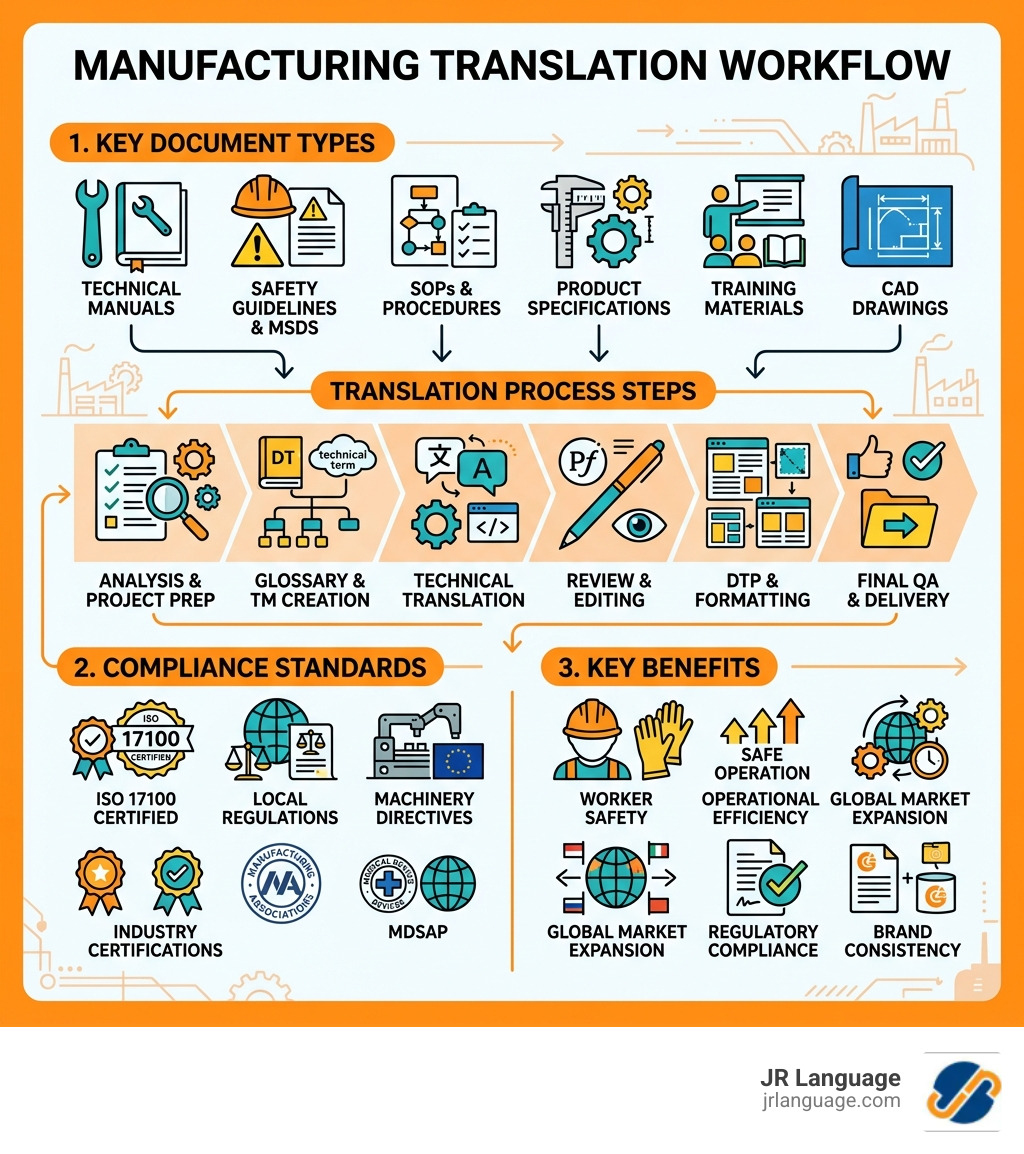
Manufacturing translations cover the full range of industrial documents:
- technical manuals
- safety data sheets
- standard operating procedures
- regulatory filings
- training materials
- product specifications
These are translated by JR Language linguists with direct subject-matter expertise in industrial and engineering fields.
What Sets Manufacturing Translations Apart?
The combination of technical precision and regulatory compliance makes industrial translation services distinct from standard document translation services.
These are two critical distinctions that require a translator well-versed in technical translation service specifications:
- Technical fidelity: Manufacturing manuals are industrial documents that contain tolerance values, alphanumeric component designations, material specifications, and terminology with no equivalent in everyday language.
- Regulatory compliance: Many manufacturing documents are legal instruments, not informational ones. Safety data sheets, hazard communications, and machinery documentation must conform to specific international standards.
| What | Manufacturing translation services convert industrial documents into target languages with technical precision |
|---|---|
| Who needs it | OEMs, exporters, plant operators, engineers, compliance teams |
| Key documents | Safety manuals, CAD files, SOPs, product specs, MSDS sheets, training materials |
| Why it matters | Worker safety, regulatory compliance, and operational efficiency across borders |
| What to look for | Subject-matter expert linguists, legal and technical translation expertise, and translation memory tools |
The Documents That Require Precision Translation
Manufacturing generates content across every phase of a product’s lifecycle. Each document type carries its own technical and compliance requirements.
Technical Manuals and Standard Operating Procedures
Technical manuals and SOPs govern how equipment is installed, commissioned, operated, maintained, and repaired. The documents accompany equipment exported to new markets or are used across multilingual plant workforces. The accuracy of these technical manual translations, consequently, has direct operational consequences.
Documents in this category include:
- Installation and commissioning guides
- Equipment operation manuals
- Maintenance and repair procedures
- Standard operating procedures (SOPs)
- Work instructions and process documentation
- Quality control and inspection protocols
Consistency matters as much as accuracy. If a single component is referred to by three different translated terms across a 300-page manual, the result is confusion at the point of use on the plant floor, at the maintenance bench, or during an audit.
Safety Data Sheets and Hazard Communications
Safety Data Sheets (SDS), previously known as Material Safety Data Sheets (MSDS), are legal documents describing the properties, hazards, and safe handling requirements of chemical substances. They are mandatory for manufacturers that produce, import, or distribute chemical products across virtually every major market.
In a multilingual manufacturing environment, there is rarely a single language. OSHA’s Hazard Communication Standard requires that SDS documents be available in a language workers can understand.
Translated SDS documents must meet both linguistic and structural standards.
Regulatory and Compliance Filings
Market entry in most regions requires documentation that satisfies local regulatory bodies. These are legal documents. Translation errors create compliance gaps that can delay market entry, trigger audits, or result in product holds.
Common filings requiring manufacturing translation services include:
- CE marking technical files for EU market access
- FDA submissions and product labeling for the US market
- REACH compliance documentation for chemical products entering the EU
- Country-specific import and customs documentation
- Environmental and emissions compliance filings
Training Materials and Onboarding Content
Multilingual workforces need training content in the languages their workers actually use. Safety training programs, equipment operation guides, onboarding materials, e-learning modules, and compliance certification content all carry risk when they exist only in a language some employees may manage in general conversation but may miss technical nuance in.
Working with professional e-learning translation services for training content is one of the most direct risk-reduction measures available to manufacturing employers.
The GHS Standard: The North Star for SDS Translations
The Globally Harmonized System of Classification and Labeling of Chemicals (GHS) is the UN-developed international framework that standardizes how chemical hazard information is communicated across borders. It has been adopted by the United States, the European Union, Japan, Canada, South Korea, Australia, and more than 70 countries in total.
For manufacturers, GHS adoption means SDS documents must conform to a specific structure in every language in which they’re translated.
The 16-Section SDS Format
GHS mandates that every Safety Data Sheet must follow a 16-section structure, in a fixed sequence:
- Sections 1–3: Product identification, hazard classification, and composition
- Sections 4–6: First aid measures, firefighting procedures, and accidental release response
- Sections 7–10: Handling, storage, exposure controls, and physical and chemical properties
- Sections 11–12: Toxicological and ecological information
- Sections 13–15: Disposal considerations, transport information, and regulatory data
- Section 16: Revision history and supplemental information
Each section using the standardized terminology of GHS hazard statements, precautionary statements, and signal words must be rendered using the GHS-approved equivalents in the target country’s implementation.
A translator working on an SDS for the German market must know that the GHS signal word “Danger” corresponds to “Gefahr” under EU CLP terminology — not simply any German word that conveys danger.
This is a compliance requirement, not a stylistic one. A translation that uses non-standard terminology in a GHS-regulated field is a non-compliant document, regardless of how accurately it conveys meaning in general language terms.
Manufacturing Translators: Why Subject-Matter Expertise Is Non-Negotiable
The most consequential decision in manufacturing translation is not which platform or workflow to use. It is who translates the content.
A linguist who is fluent in both German and English but has no industrial background will produce a German translation of a CNC machine manual that is grammatically correct and operationally unreliable. The problem is not language competence but domain knowledge.
What is the Relevant Expertise for Industrial Translations?
For translation services for manufacturing, subject-matter expertise means:
- direct professional experience in the specific industrial sector
- familiarity with the technical terminology and standards bodies of that field
- an understanding of the regulatory environment in both source and target markets
- hands-on experience with the document types being translated
Manufacturing documents also include legally defined terms that have specific regulatory meanings:
- In EU machinery documentation, “putting into service” has a defined legal meaning under Regulation (EU) 2023/1230
- In US chemical labeling, “flammable” and “combustible” are distinct GHS classifications
Translators without regulatory grounding will normalize these into natural-sounding language that is technically incorrect and potentially non-compliant. This is why, at JR Language, we routinely work with experts in both technical and legal translations.
Common Questions About Manufacturing Translation Services
What are Manufacturing Translation Services?
Manufacturing translation services convert industrial documents into target languages using translators with direct subject-matter expertise in engineering and industrial fields. Examples include technical manuals, safety data sheets, standard operating procedures, regulatory filings, and training materials. The combination of technical precision and regulatory knowledge is what distinguishes this from general business translation.
Which Types of Manufacturing Documents Require Professional Translation?
The most common are technical manuals, standard operating procedures, safety data sheets, equipment installation guides, and regulatory compliance filings. Training materials and quality control documentation also frequently require translation for multilingual plant workforces.
Is Manufacturing Translation Different from General Business Translation?
Yes, in two significant ways. Manufacturing content contains technical terminology, tolerance values, and alphanumeric designations that require domain expertise, not just language fluency. Many manufacturing documents are also legal instruments with specific regulatory formatting requirements that a generalist translator may not recognize.
What is GHS, and Why Does It Apply to My Safety Data Sheets?
The Globally Harmonized System (GHS) is a UN-developed international framework that standardizes how chemical hazard information is structured and communicated across borders. It has been adopted by over 70 countries, including the US, EU, and Japan. GHS mandates a specific 16-section format for safety data sheets; SDS translations must conform to GHS-approved terminology in each target market.
Precision and Accuracy for Your Translated Documents in Manufacturing
Your technical documentation, safety data sheets, and regulatory filings represent the engineering and compliance work behind your products. Translating them accurately requires more than language fluency. You must also comply with the specific regulatory standards of each market.
You need legal and technical translators who understand what the content is supposed to mean, not just what it says.
Reach Out to Us Today!
JR Language Translation Services provides manufacturing translation services backed by subject-matter experts and translation memory infrastructure built for high-volume industrial content. Preparing EU machinery documentation? Localizing safety training for a multilingual plant workforce? Managing SDS compliance across multiple markets?
Our manufacturing translation company has domain expertise and regulatory knowledge to do it right. Consult with us today to discuss your manufacturing translation requirements and more!


