Maria submitted her Green Card application with confidence—until USCIS rejected it. The reason? Her cousin translated her Spanish birth certificate, and USCIS doesn’t accept translations from family members. Six months and $1,500 in reapplication fees later, she learned that professional translation services aren’t optional for official documents—they’re essential.

Understanding Spanish Birth Certificate Translation Requirements
Spanish birth certificate translation converts your official birth record from Spanish to English while meeting strict government and institutional standards. This certified Spanish translation process requires a complete word-for-word translation with a signed statement from a qualified, impartial translator.
At JR Language Translation Services, we understand that your Spanish birth certificate is more than paperwork—it’s your key to immigration approval, university admission, and life milestones in the United States. An inaccurate or improperly certified translation causes rejected applications, significant delays, and legal complications.
Quick Requirements:
- Who translates: Qualified, impartial third-party translator (never yourself or family)
- What’s included: Complete certified translation with translator’s signed statement
- Standard turnaround: 24-48 hours
- Accepted by: USCIS, passport offices, universities, courts, and legal proceedings
Why Official Birth Certificate Translation Is Required
U.S. institutions cannot process documents they cannot read. Your Spanish birth certificate, while valid in its home country, requires professional translation for official U.S. use.
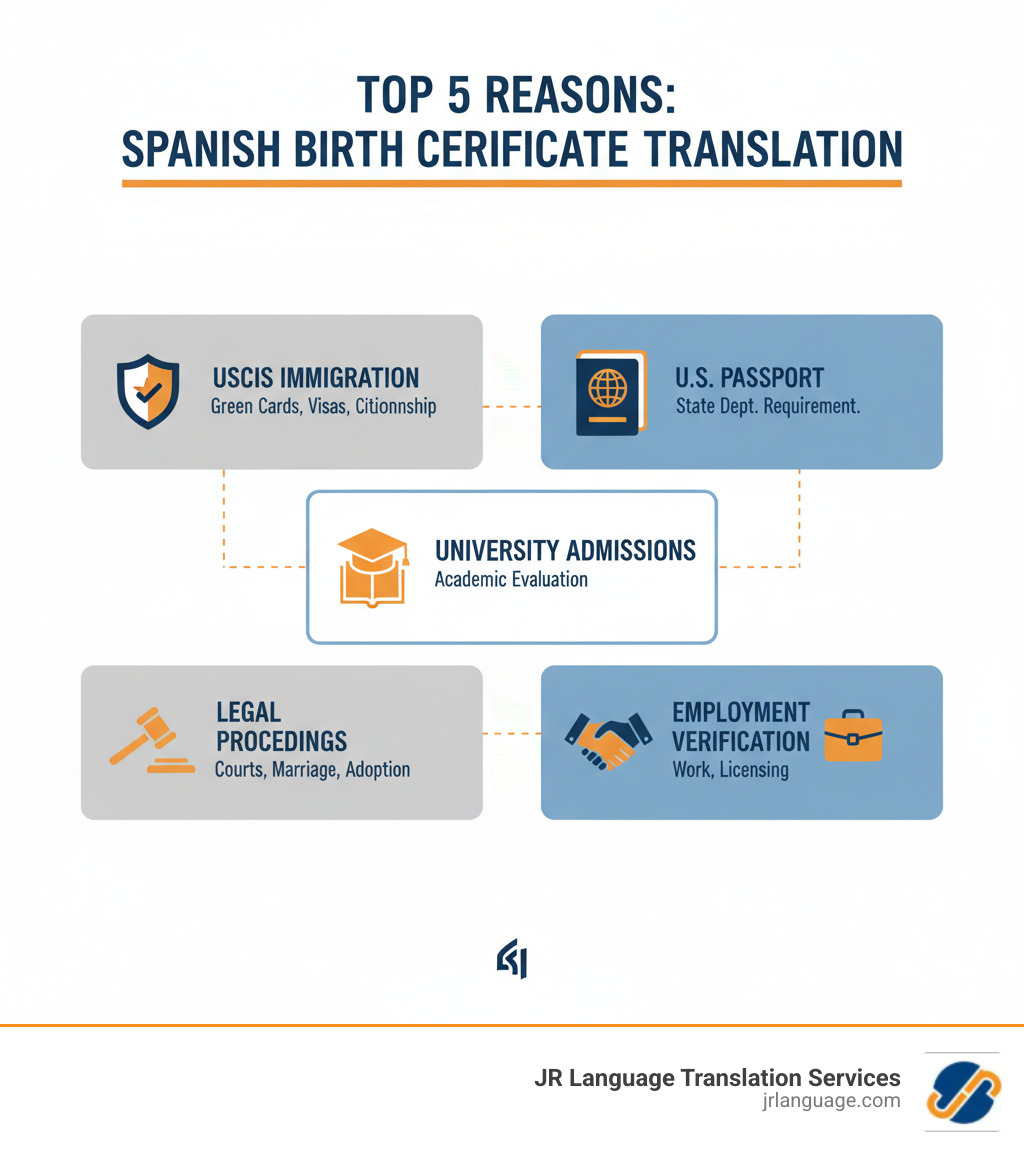
Primary Situations Requiring Certified Translations
USCIS immigration applications have non-negotiable requirements for certified English translations for Green Cards, visas, or citizenship applications.
U.S. passport applications through the State Department require certified translations to verify identity and eligibility.
University and college admissions rely on translated birth certificates to confirm identity and academic background.
Legal proceedings, including family courts handling adoption or custody cases, require certified translations for accuracy and clarity.
Local government offices issuing marriage licenses request translated birth certificates to prove identity and eligibility.
Additional scenarios include employment verification, background checks, Social Security benefits applications, and professional licensing.
Institutions Requiring Certified Translations
Common authorities include:
- United States Citizenship and Immigration Services (USCIS)
- U.S. Department of State
- Universities and credential evaluation services
- State and federal courts
- Social Security Administration
- Department of Motor Vehicles
- Consulates and embassies
- Professional licensing boards
Spanish birth certificate translation is required when you submit your birth certificate to U.S. government agencies, universities, or courts. Here’s what you need to know:
Quick Answer:
- Who can translate: A qualified, impartial third-party translator (NOT yourself or family members)
- What’s required: A complete word-for-word certified translation with the translator’s signed statement
- Where it’s accepted: USCIS, passport offices, universities, courts, and legal proceedings
Whether for U.S. immigration, university enrollment, or legal matters, your Spanish birth certificate requires an official English translation. An inaccurate or improperly certified translation can cause rejected applications, significant delays, and legal issues, as agencies like USCIS have strict requirements.
Fortunately, the process is simple once you know the rules. Certified translations are widely accepted by governments and institutions when they meet the proper standards.
Key Requirements for Certified Translations
Getting your translation right the first time prevents rejected applications and costly delays. Official bodies like USCIS have strict requirements ensuring document accuracy and trustworthiness.
Complete Word-for-Word Translation
Your certified translation must include everything from the original Spanish birth certificate: text, stamps, seals, and handwritten notes. Nothing can be summarized or omitted. If any part is illegible, the translator must note it as “illegible.”
The translation should mirror the original format closely, following the same layout of columns or tables. This makes cross-referencing easy for officials comparing the translated document with the original.
Understanding Translation Types
Certified Translation is the standard for most U.S. purposes, including USCIS. It includes a signed Certificate of Translation Accuracy on company letterhead, attesting to accuracy and completeness. The professional translator or translation company provides this certification.
Notarized Translation adds authentication where a Notary Public verifies the identity of the person signing the certification—not the translation itself. Some specific legal or financial institutions require this additional layer. Always verify requirements before ordering.
Sworn Translation is required in countries with civil law systems like Spain or Mexico. Government-appointed translators perform these legally valid translations. If you need a translation for use outside the U.S., you may need this type. Translation agencies with international networks can provide sworn translators.
Who Can Provide Certified Translations
You cannot translate your own birth certificate for official purposes. Family members and friends are also unacceptable. Official institutions require impartial third-party translators to guarantee objectivity and accuracy.
Qualified Translator Criteria
A qualified translator is a professional competent in both Spanish and English who understands specific terminology and formatting required for official documents. Native speakers with expertise in legal documents from across the Spanish-speaking world provide the highest quality translations.
Required Certification Statement
Every certified translation must include a translator’s certification statement—a formal declaration printed on company letterhead stating the translation is accurate and complete. It includes:
- Translator’s name, signature, and date
- Contact information
- Affirmation of competence in both languages
Working with reputable providers, especially American Translators Association (ATA) members, ensures high professional standards and peace of mind.
Obtaining Your Original Spanish Birth Certificate
Before ordering translation, obtain the original document from the Spanish Civil Registry (Registro Civil).
For U.S. purposes, request the literal certificate (Certificado Literal de Nacimiento). This complete, verbatim copy of the birth record is what U.S. authorities prefer over the summary version (extract certificate or Certificado en Extracto).
You can request your certificate:
- Online via the Spanish Ministry of Justice’s website
- In person at the relevant Civil Registry office in Spain
- By mail to the appropriate registry
The online method is often most convenient. Once you have your original document, provide a clear copy to your translation agency for certified translation.
The Translation Process Explained
Step 1: Submit Your Document
Provide a clear digital copy of your Spanish birth certificate. A high-quality scan or well-lit photo works. Ensure all text, stamps, and signatures are legible. Common formats like PDF, JPG, and PNG are accepted.
Step 2: Receive a Quote
Upload your document to the translation company’s secure platform. You’ll receive a transparent quote with no hidden fees. Select additional services like notarization if needed.
Step 3: Professional Translation and Certification
Your document is assigned to a professional translator specializing in official Spanish documents. They perform a complete, word-for-word translation mirroring the original’s format. After quality assurance review, the signed Certificate of Translation Accuracy is attached, validating the translation for official use.
Step 4: Receive Your Translation
For standard documents, receive your certified digital translation via email within 24-48 hours. This PDF suits most online submissions, including many USCIS applications. Physical copies with original signatures (required for some applications like U.S. passports) are available via standard or expedited mailing.
Frequently Asked Questions
Can I translate my own Spanish birth certificate for USCIS?
No. USCIS requires certified translation from an impartial, competent third party to ensure objectivity and accuracy. Professional translation services provide necessary third-party certification, confirming accuracy and no personal stake in your application. Self-translations or family member translations will be rejected.
While technically anyone fluent in both languages can provide translations, USCIS officers may question translations with conflicts of interest. Professional translators eliminate this risk entirely.
What must be included in the certification statement?
The certification statement is the formal declaration making your translation official. It must include:
- Statement attesting to translation accuracy and completeness
- Translator’s (or company representative’s) name and signature
- Translation provider’s contact information
- Translation date
- Declaration of translator’s competence in both Spanish and English
Professional services provide certifications on official letterhead carefully crafted to meet all USCIS requirements.
What are the consequences of submitting an inaccurate translation?
Submitting inaccurate or improperly certified translations causes serious consequences:
Application rejection: Your entire application (immigration, university, etc.) can be rejected, forcing you to restart and pay fees again.
Significant delays: Agencies may issue Requests for Evidence (RFE), adding months to processing times.
Legal complications: Major errors could be viewed as misrepresentation, potentially leading to fraud accusations or benefit denial.
Professional translation services minimize these risks by ensuring translations are accurate and properly certified from the start.
Do I need the literal or an extract birth certificate from Spain?
For U.S. purposes, always request the literal certificate (Certificado Literal de Nacimiento). This complete, verbatim copy contains all information related to your birth identity. U.S. authorities, particularly USCIS and the State Department, prefer this comprehensive version over the summary extract certificate.
The literal certificate includes all data, stamps, and annotations in the original registry entry. The extract certificate provides only a summary and may lack details required by U.S. institutions.
Ensuring Your Translation Is Accepted
Navigating Spanish birth certificate translation is straightforward when you follow the right steps. Accuracy and proper certification are non-negotiable. A complete, word-for-word translation with certification from a qualified, impartial third party is essential to avoid rejections and delays.
Native, industry-experienced translators ensure linguistic precision plus cultural and contextual correctness—critical for official documents submitted for USCIS, university admissions, or legal matters.
At JR Language Translation Services, we deliver fast, affordable, high-quality certified translations daily. Our teams across the United States—from Miami and New York to Los Angeles and Houston—understand the urgency and importance of your documents. We’ve helped thousands get it right the first time.
Your birth certificate is your key to future opportunities. Professional translation services handle this critical document with the expertise it deserves, ensuring acceptance by every institution that requests it.
Ready to move forward with confidence? Get your certified translation today and take the next step toward your goals with peace of mind.