

A startup in Chicago lands its first partnership with a distributor in Colombia. The contracts need to be in Spanish. They must be legally sound, properly formatted, and ready to sign. The HR team at a hospital in Phoenix is onboarding a new cohort of employees. Many of them speak limited English. The handbook needs to work in both languages before orientation week. A family in Atlanta is preparing an immigration application. They need three years of documents translated and certified before their appointment.
None of these situations requires walking into an office. All of them require a professional.
Online translation services connect individuals and organizations with qualified, native-speaking translators through digital platforms. No geographic constraints. No in-person meetings required. The work gets done remotely. The delivery is fast. The output holds up to whatever standard the situation demands. This could be USCIS acceptance, a corporate legal review, or a marketing team’s approval.
For anyone searching for professional translation services today, this is simply how the industry operates. The quality level matches or exceeds what was previously only available through in-person providers.

What “Online Translation Services” Actually Means
When someone searches for translation services online, they’re usually looking for one of two things: a tool or a professional. These are not the same. Free browser-based tools, such as Google Translate, DeepL, and similar platforms, are widely available. These are useful for getting the general meaning of a text. However, they are not suitable for documents that carry legal weight. Those documents require cultural accuracy. Those may be reviewed by an institution with specific formatting expectations. They are also, as discussed in any serious conversation about data security, inappropriate for confidential document translations.
The Value of Professional Translators
Professional AI translation services, by contrast, are delivered by vetted human translators. We specialize in specific subject areas and language pairs. The process happens digitally. You submit your documents through a secure portal. A project manager assigns the right linguist. The document translation goes through a quality review. And you receive a finished, delivery-ready file. But the work itself is human, expert, and accountable. That distinction matters enormously when the stakes are higher than a casual conversation. Even for raw machine translations, which are used for a high volume of content needing immediate delivery, usually the understanding is that someone from the organization requesting the translations will be vetting the final output. The message is simple: A qualified human must always be in the loop.
The Demand Driving Online Translation Today
Two converging trends are driving consistent growth in demand for professional translation services: corporate and personal.
The Business Side
On the business side, the global remote workforce has fundamentally changed how organizations hire, operate, and communicate. The number of digital remote work positions globally is projected to grow to 90 million by 2030. As companies hire across borders and manage diverse teams, the need for translated contracts, HR materials, compliance documentation, and business communications has grown in parallel. Organizations that once needed human resources translations and other multilingual corporate materials sporadically now need it as a routine part of operations.
The Individual Side
The U.S. immigrant population grew by approximately 5% in recent years, as per U.S. Census Bureau data. That’s more than 2.4 million people newly arrived in the States speaking a multitude of languages other than English. Every immigration journey involves documents: translated birth certificates, marriage records, academic transcripts, court records, and financial statements. All of them require USCIS-certified translations. These need to be right the first time. 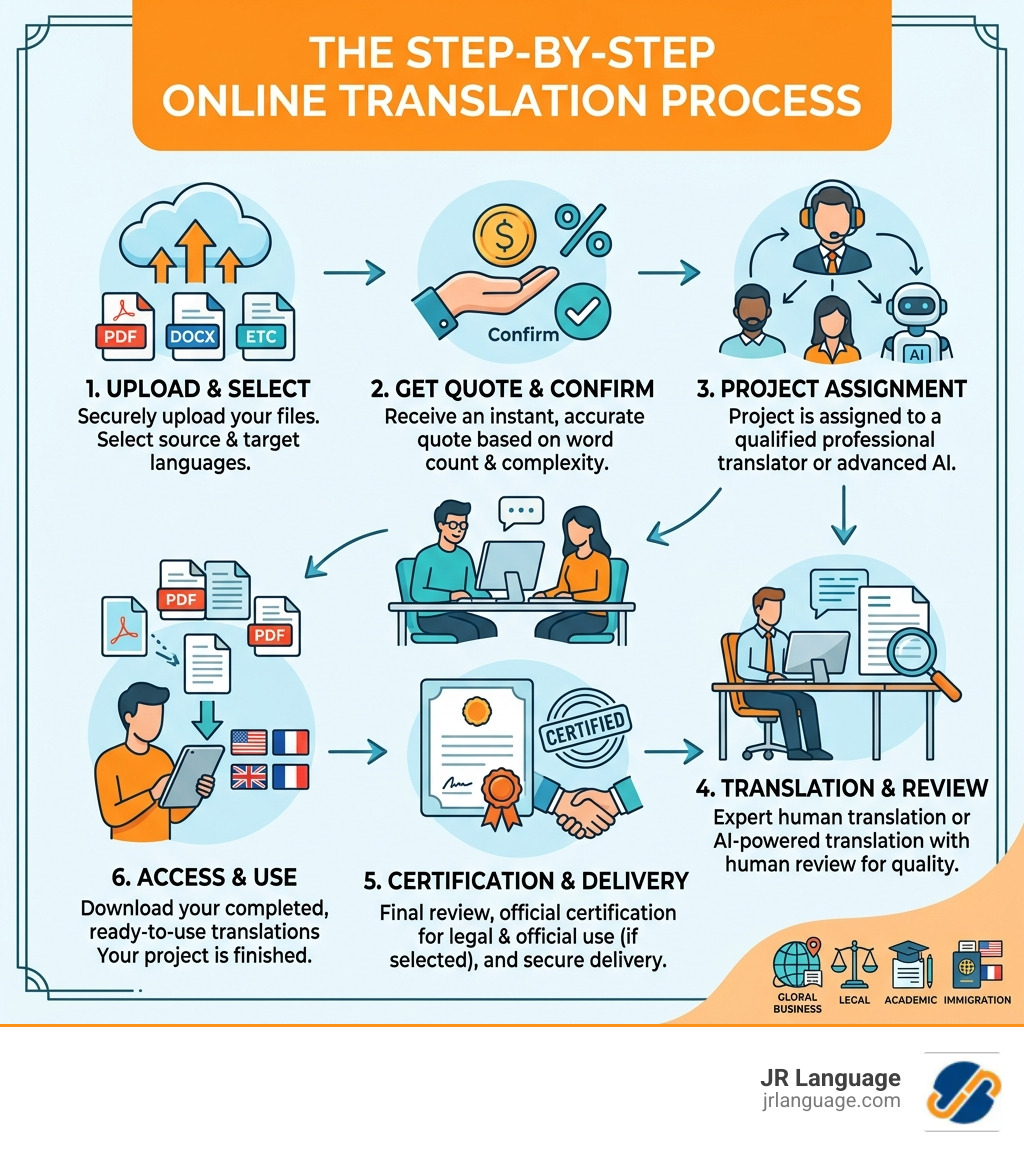
Types of Professional Translation Services Available Online
Certified Translation for Official Use
Certified translation is required whenever a government agency, court, or institution needs to verify that a translated document accurately reflects the original. For USCIS filings, this means a complete translation accompanied by a signed Certificate of Accuracy on the translation company’s letterhead. Universities, courts, and professional licensing bodies have similar requirements.
Legal and Business Document Translation
Contracts, partnership agreements, corporate filings, HR documentation, compliance materials, and financial records all require translators with subject-matter expertise — not just language skills. A translator working on a cross-border merger agreement needs to understand how contract language functions differently across legal systems. One working on an employee handbook needs to know how to convey policy in natural, professional language that reads as written for the target audience, not translated from somewhere else.
Marketing and Website Translation
For businesses expanding into new markets or serving multilingual audiences domestically, marketing translation is its own discipline. Product descriptions, campaign copy, landing pages, social content, and email sequences all require translators who understand brand voice and audience expectation, not just vocabulary. The output needs to feel like it was written for that audience, not converted from English.
Medical and Technical Translation
Healthcare organizations translating patient-facing materials, informed consent forms, clinical documentation, or insurance documents operate under HIPAA compliance requirements that extend to every vendor who handles patient information — including translation providers. Technical industries translating product manuals, safety data sheets, engineering specs, or patent applications need translators with direct experience in those fields.
Why Online Translations Work For All These Industries
In all these cases, online delivery doesn’t diminish the quality of the work. What matters is the translator’s qualifications and the provider’s quality assurance process. Rather, online delivery makes this type of work more accessible than ever. A law firm managing an international case or a company rolling out Spanish-language HR materials doesn’t need a local provider. They need the right provider, regardless of geography.
What to Look For in an Online Translation Provider
The ability to submit and receive documents digitally has made the market more crowded. Not every provider operating online offers the same standard of quality, security, or professional accountability. A few things worth verifying before you share a single file:
- Translator qualifications: Are the translators native speakers with verified expertise in the relevant subject area? Subject-matter knowledge is not optional for legal, medical, or technical content.
- Certification capability: For any document destined for a government agency, court, or institution, the provider should deliver a properly formatted Certificate of Accuracy with an authorized signature.
- Data security: File transfers should be encrypted, and every linguist handling your documents should be bound by a signed non-disclosure agreement. You should never submit sensitive documents through an unsecured email or a general-purpose free platform.
- Quality review process: Professional translation involves at least two stages—translation and review by a second qualified linguist. Providers who skip this step introduce unnecessary risk into the final product.
- Responsive project management: For time-sensitive submissions or complex projects spanning multiple document types, direct access to a project manager makes the process significantly smoother.
JR Language: Professional Online Translation Services, Wherever You Are
At JR Language Translation Services, our network of native-speaking, industry-experienced translators is distributed globally. Your location has no bearing on the quality or speed of service you receive.
Need a single birth certificate translated and certified for an immigration application? Is your company a full suite of HR documents localized for a Spanish-speaking workforce? Or do you require ongoing multilingual content support for a business operating across multiple markets? No matter your translation project, we handle it with the same professional rigor.
Submitting documents is straightforward, turnaround is dependable, and every project is handled under strict confidentiality protocols. Contact our team to discuss your translation needs.


