

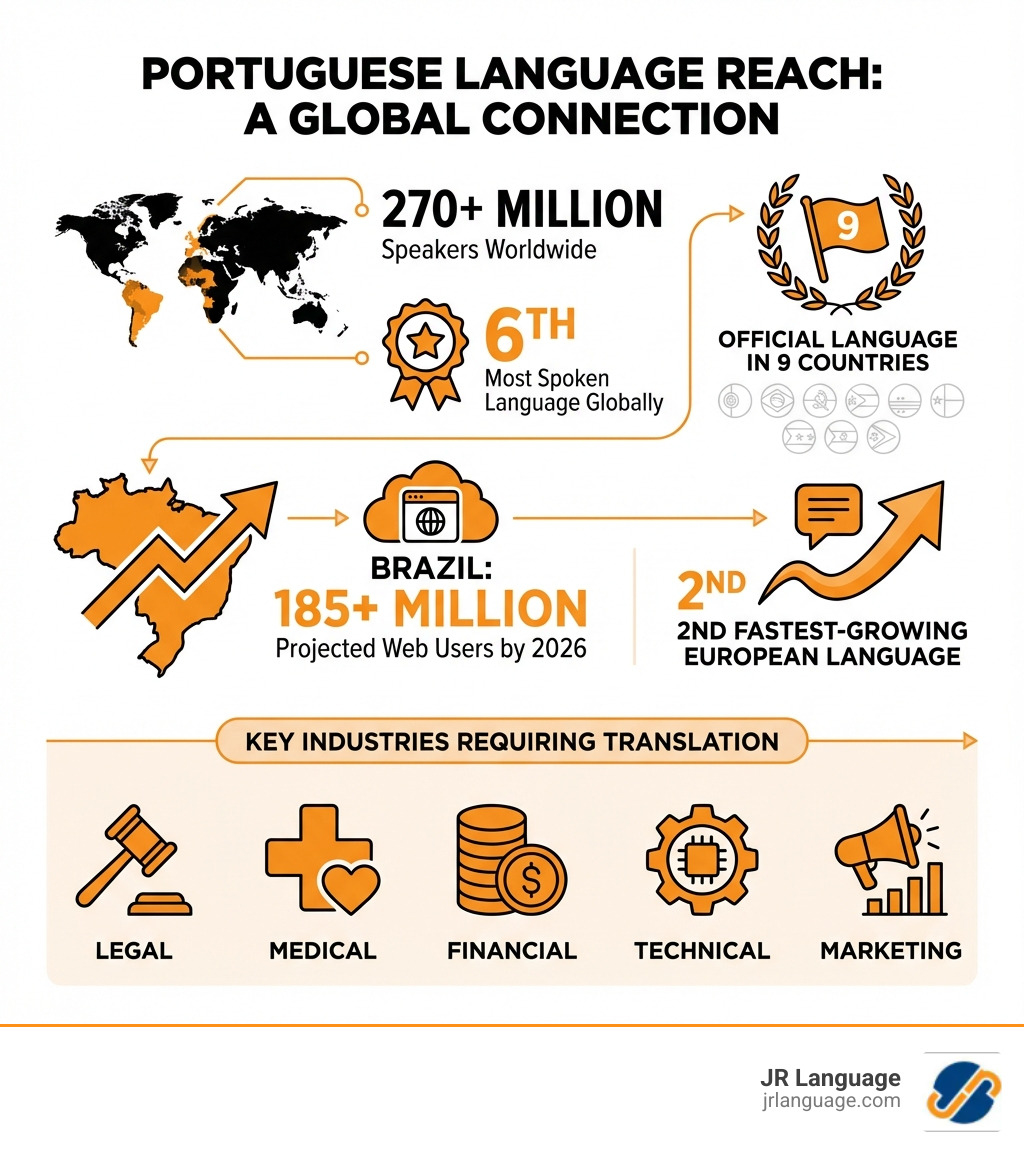
Portuguese is the official language of nine countries across four continents. This makes it one of the most geographically distributed languages on earth.
But those nine countries don’t share a single written or spoken standard. A social media marketing post translation that works for São Paulo can read as foreign or off-putting in Lisbon. A document localized for Portugal may sound stiff and outdated to a Brazilian reader.
Content prepared for either of those markets will miss the mark entirely in Luanda or Maputo.
How This Affects Portuguese Translation Service Options
This is the foundational reality for professional translation service providers working with Portuguese documents: the language is one, but the markets are distinct. Accuracy requires knowing which version of Portuguese your audience actually speaks.
Portuguese translation services convert documents, digital content, and communications from Portuguese into English, or from English into the specific Portuguese variant used by your target market. At JR Language, we focus on both linguistic accuracy and the cultural adaptation required in each region.

The Full Coverage of Our Portuguese Language Services
The service category spans a wide range of content and use cases of the following and more:
- Portuguese document translation for business, legal, and personal use
- Certified translation for immigration, government, and academic submissions
- Website and digital content localization for Brazilian, European, or African Portuguese markets
- Portuguese interpretation services for live meetings, legal proceedings, and conferences
- Technical translation for manuals, product specifications, and engineering content
- Transcription services for audio and video content in Portuguese
The right scope for any given project depends on the document type, the target market, and whether the goal is English to Portuguese translation or Portuguese to English translation services.
Brazilian vs. European Portuguese: Why the Distinction Is Non-Negotiable
A Language That Diverged Over Centuries
Brazilian Portuguese and European Portuguese share a common origin. But these have diverged substantially over five centuries of separate development.
Brazilian Portuguese absorbed significant influence from
- Tupi and other indigenous languages
- West African languages brought during the colonial period
- Immigration from Italy, Germany, and Japan in the nineteenth and twentieth centuries
European Portuguese evolved along a different path. It retains closer ties to its Iberian roots while developing its own distinct phonology.
The result is two varieties of the same language that are mutually intelligible in writing. At the same time, these are immediately recognizable to native speakers as distinct.
Differences That Affect Translation Directly
The divergence between Brazilian and European Portuguese shows up in ways that matter concretely for translation:
- Vocabulary: Everyday words differ significantly. A bus is ônibus in Brazil and autocarro in Portugal. A refrigerator is geladeira in Brazil and frigorífico in Portugal. These aren’t regional accents. They’re different words entirely.
- Verb forms and pronouns: Brazilian Portuguese largely dropped the second-person singular tu from everyday speech in favor of você, which takes third-person verb conjugations. European Portuguese uses tu with its own conjugations. The same sentence addressed to “you” reads differently in each variant.
- Spelling and orthography: Despite the Orthographic Agreement that brought the two standards closer, differences in spelling and accentuation remain, particularly for words derived from Latin roots.
- Tone and register: Brazilian Portuguese tends toward more open, informal registers in business communication. European Portuguese business writing is typically more formal. Marketing copy that resonates with a Brazilian audience can read as overly casual to a Portuguese one.
Using the wrong variant is confusing. It also signals to readers that the content wasn’t written for them.
For brand credibility, that signal matters.
When to Specify Brazilian Portuguese Translation Services
Brazilian Portuguese translation services are applicable whenever your audience is in Brazil or in Brazilian diaspora communities in the US and Europe.
Brazil is the largest Portuguese-speaking country by population and the largest economy in Latin America. This makes it the default target for most businesses entering Portuguese-speaking markets for the first time.
European Portuguese is used in Portugal and is also the reference standard for Macau and parts of the Lusophone community in former Portuguese territories in Asia.

African Portuguese: The Markets Most Translation Providers Don’t Address
The Lusophone Africa Opportunity
Angola, Mozambique, and Cape Verde represent a distinct segment of the Portuguese-speaking world, with growing economic significance that most businesses overlook when planning their Portuguese translation strategy.
- Angola has been one of sub-Saharan Africa’s largest oil producers for decades, and its economy has diversified significantly as it has attracted foreign investment in infrastructure, agriculture, and telecommunications.
- Mozambique holds some of the largest natural gas reserves discovered in sub-Saharan Africa in recent years, with major projects led by international energy companies drawing significant foreign direct investment.
- Cape Verde has developed as a stable financial services and tourism hub with strong trade ties to both Europe and other African nations.
For companies in energy, infrastructure, financial services, or international development operating in these markets, Portuguese translation services that account for African Portuguese variants are a market entry requirement.
How African Portuguese Differs
African Portuguese carries its own vocabulary, constructions, and cadences shaped by contact with local languages:
- Kimbundu and Kikongo in Angola
- Emakhuwa and other Bantu languages in Mozambique
- Kriolu in Cape Verde
The variety spoken and written across Lusophone Africa is neither Brazilian nor European Portuguese, and content localized for either of those markets will read as imported rather than native to an African audience.
At JR Language, we focus on more than just general Portuguese fluency or experience with Brazil or Portugal. Our translators working on content for Angolan, Mozambican, or Cape Verdean markets have direct familiarity with the local variant.
Getting the Right Portuguese Translation Service for Your Needs
The Portuguese-speaking world spans nine countries across four continents and several hundred million people. But it doesn’t operate as a single market. Neither should it be translated as one.
Getting your Portuguese translation right means:
- specifying which variant you need
- matching that need to a translator with direct regional and subject-matter expertise
- ensuring that certified documents meet the exact formatting and accuracy standards of the receiving institution
Work With Our Portuguese Interpreters and Translators Today!
JR Language Translation Services provides Portuguese translation and interpreting services across Brazilian, European, and African Portuguese. Our native-speaking translators and interpreters are matched to your specific market and document type.
No matter your Portuguese document translation or meeting interpretation needs, we have the regional expertise to handle it all accurately. Reach out to us today – we are happy to help!


