A national insurance company launches a Spanish-language version of its member portal. The translation goes live. Within days, the customer service team starts fielding confused calls. The language is technically correct. It’s grammatically sound. There are no obvious errors. But it reads as strange and slightly cold to the company’s predominantly Mexican-American customer base in Texas and California.
The culprit: the translation used Castilian Spanish conventions from Spain, not the Latin American Spanish that their audience speaks every day.
Expert Translators Match Your Communication Needs to the Correct Dialect
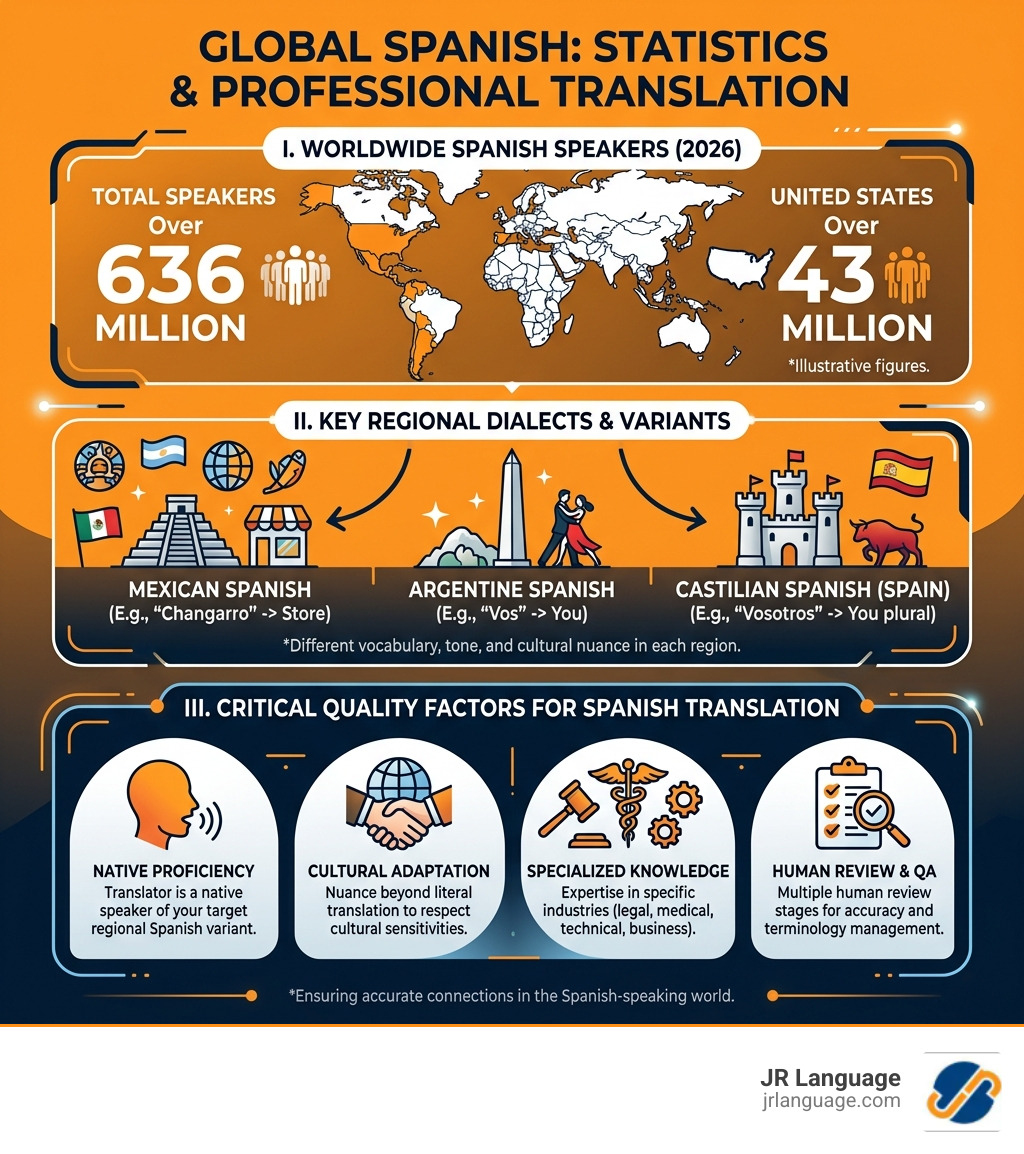
This kind of mismatch is common without a professional Spanish translator. This is exactly why you need professional translation services. Spanish is the official language of 21 countries across four continents. It is spoken by more than 636 million people worldwide.
There is no single, universal “Spanish”. There are regional variants and cultural registers. Audience expectations shift meaningfully across geography. Finding the right Spanish translator means understanding that distinction before a single word gets submitted for document translation.
The Spanish-Speaking Market Today Demands Professional Attention
The business case for investing in professional Spanish translation services has never been stronger. The U.S. Latino purchasing power reached $3.78 trillion in recent years. Also, today, 44.9 million people aged five and older speak Spanish at home in the United States — more than twice as many as in 1990. That’s a domestic audience of consumers, employees, patients, and community members. With Spanish business translations, your organization interacts more comfortably with them in their language — specifically, their regional variant.

Spanish Across 21 Countries: Why Regional Expertise Defines the Work
Looking for Spanish interpretation and translation services? You may know that the language varies by region. But you may not realize exactly how it matters for your project.
Here’s what professional Spanish linguists have to navigate:
Mexican and Latin American Spanish
This variant is the most widely spoken form of Spanish in the United States. It has its own vocabulary, idioms, and tonal conventions. These differ from those of European Spanish.
In business and marketing contexts, it tends toward warmth and directness in consumer-facing communication.
Rioplatense Spanish
This is widely spoken in Argentina and Uruguay. It has one of the most distinctive regional variants. It is characterized by a different second-person pronoun (vos instead of tú). It has its own set of idioms and slang.
A translator working on content for an Argentine audience who doesn’t know Rioplatense will produce text that sounds unmistakably foreign to that readership.
Caribbean Spanish
This is spoken in Cuba, Puerto Rico, the Dominican Republic, and coastal Venezuela and Colombia. It features rapid speech patterns. There is consonant softening or omission. The vocabulary has stronger African and indigenous influences than other variants.
Healthcare organizations serving Puerto Rican communities in New York or Chicago need translators who know this variant specifically, not generic Latin American Spanish.
Castilian Spanish
This is spoken in Spain. It uses different vocabulary for everyday concepts. For example, a car is a coche in Spain, a carro or auto in Latin America. It uses a different second-person plural pronoun, vosotros, which doesn’t exist in Latin American Spanish. There is a distinctive pronunciation of the letters c and z as a soft th sound.
Spanish-language content written for European markets requires a translator who works in this variant. Content written for U.S. or Latin American audiences almost certainly does not.
The Practical Implications of Different Dialects
Before hiring a professional Spanish translator, the question isn’t just “do they translate Spanish?” It’s “which Spanish, for which audience?”
Work with native translators who are regionally grounded in your target market. They will produce content that reads as if it were written for that audience. Someone who merely knows the language, without an understanding of variations, will produce content that technically says the right things. However, that translated document will fall short. It will subtly signal it wasn’t made for them.
Localized Spanish Translations for Your Target Audience
Cultural awareness means the translated text sounds like it was written for the target audience. It does not feel like it was just translated into their language. Think of tone, register, and idiomatic expressions. Consider all the signs of cultural familiarity that make content feel either natural or foreign.
Professional Translators Also Bring Industry Expertise
Subject-matter precision means the translator has real expertise in the relevant field. They will know legal terminology for contract work. They will be well-versed in clinical vocabulary for healthcare translation. They will understand regulatory language for compliance documentation. A talented general translator is not the same as a talented legal Spanish translator or medical Spanish translator. The specialization is part of the qualification.
Certified Spanish Translation: For Your Official Documents
For immigration filings and university admissions, a certified Spanish translation is required. A certified Spanish translation includes a signed Certificate of Accuracy, confirming the document is an accurate representation of the original. USCIS has specific formatting requirements for certified translations submitted with immigration applications. Your document may get rejected if it doesn’t meet those standards.
Common Documents Requiring Certified Spanish Translations
These include birth certificates in Spanish, marriage and divorce records, passports, and academic transcripts. You may also need these for legal judgments and financial records. For individuals navigating the U.S. immigration system, the certified translation of these documents is often one of the most consequential steps. It is where accuracy and proper certification cannot be compromised.
English to Spanish vs. Spanish to English: Different Skills, Different Needs
These two directions are often treated as interchangeable. They aren’t.
English to Spanish Translations
Producing Spanish content from English source material requires a translator who writes with fluency and native authority in the target language. The output needs to feel like it was drafted in Spanish, not converted from English.
This is the direction most relevant for marketing content and HR materials. It applies to product documentation and legal agreements. It is especially important for any client-facing or employee-facing communication in Spanish.
Spanish to English Translations
Converting Spanish-language documents into English requires a translator who reads Spanish with complete comprehension, including regional and colloquial usage, and writes English with professional clarity.
This is most relevant for reviewing contracts with Spanish-speaking partners. You’ll need this to process immigration and legal documents. You may need to translate testimony or depositions. We’ll help handle any situation where a U.S. organization needs to accurately understand Spanish-language source material.
Both Require Professional Language Experts
Both directions require native-level fluency in the target language — the language in which the text is written — not just in the source language being read.
At JR Language Translation Services, our Spanish-language team comprises native-speaking professionals across the full range of regional variants. We work with experts fluent in Mexican and Latin American Spanish, Rioplatense, Caribbean, Castilian, and more. Our translators and interpreters bring subject-matter expertise across legal, medical, technical, HR, marketing, and business content.
The Right Spanish Translator for Your Audience, Your Industry, Your Deadline
Need English-to-Spanish translation for a corporate market entry? Spanish-to-English translation for legal review? Looking for certified Spanish translation services for immigration? We match your project to the right linguist for the audience and the work.
Contact our team to discuss your project! Receive a free quote today. Schedule a consultation, and let’s go over your exact needs. We’ll match the regional and subject-matter background of the translators assigned to your content.