

Your company just landed a contract in Germany! Now you need all that technical documentation translated. Product manuals, safety specs, training materials, regulatory submissions. Hundreds of pages that need to be worked on in another language.
This is where most companies hit a snag. They know technical translation matters, but often not what sets these apart.
Here’s the answer: professional translation services for technical content keep the precision, clarity, and functionality that make documentation actually work. Get it right, and translation becomes your growth engine. Get it wrong, and you’re stuck watching competitors grab markets you should own.
“The biggest misconception about technical translation is that fluency in two languages is enough. It’s not even close. When we’re translating engineering specifications for manufacturing clients or regulatory submissions for medical device companies, our translators need to understand the underlying technical concepts as deeply as the language itself. That’s why every translator on our team brings real-world technical expertise. They speak the language of your industry, not just the language of your customers.” – Sergio Ruffolo, President, JR Language Translation Services
Why Professional Translation Services Matter Now More Than Ever
Technical Mistakes Have Real Consequences
Think about what goes into your technical documentation. Engineering specs with tolerances measured in microns. Software strings where one wrong character can crash entire systems. Medical device instructions where “before” and “after” aren’t interchangeable. Patent applications where one fuzzy term kills years of R\&D.
Fortune 500 companies lose an average of $12 billion annually due to inefficiencies caused by poorly managed technical documentation. This directly impacts their ability to serve global markets effectively.
Professional translation services exist because Google Translate can’t handle these stakes. Neither can bilingual employees who happen to speak the target language. Technical user manual translations, for example, need someone who understands both the language AND the engineering principles, medical protocols, or manufacturing processes behind what they’re translating.
The Business Case for Getting Translation Right
When we talk about document translation services, software localization, or specialized business translation, we’re talking about expertise that stops million-dollar mistakes cold.
Companies that nail translation enter markets faster, satisfy regulators more easily, and build customer trust quickly. Smart translation investment opens new revenue streams while protecting your reputation across borders.

What Sets Technical Translation Apart From Everything Else
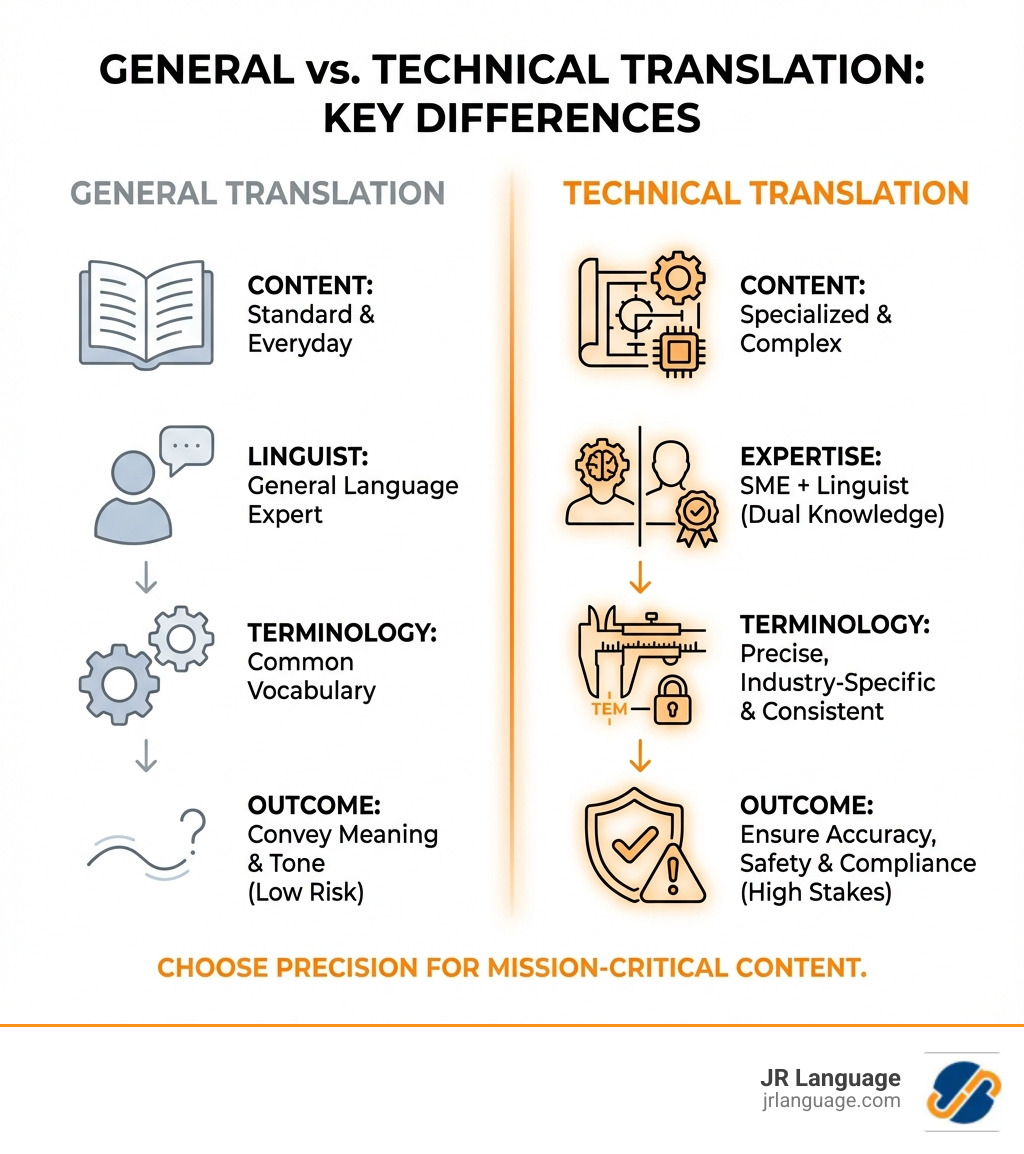
Subject Matter Expertise Isn’t Optional
You wouldn’t ask a chef to do brain surgery, even though they’re great with knives. Same deal here.
Technical translators need two things: solid language skills and legitimate subject matter knowledge. That combination is rare. It’s also non-negotiable.
A general translator might accurately convert individual words from English to German. But without an engineering background, they’ll miss that “tolerance” means something specific in manufacturing contexts, not just “acceptance of differences.” They won’t catch that in IT documentation; “server” could mean hardware, software, or even a person, depending on context.
Industries Where Precision Makes All the Difference
Engineering & Manufacturing
Assembly instructions, CAD drawings, quality control procedures, and technical specs. One wrong measurement unit—switching feet for meters—and you’ve got parts that don’t fit, delays cascading through production, and angry customers demanding refunds.
Medical Devices & Pharmaceuticals
Patient information leaflets, clinical trial protocols, regulatory submissions, and drug labels. Medical translation services handle content where errors don’t just cost money—they put lives at risk. Regulatory bodies worldwide have zero tolerance for ambiguous healthcare translations.
IT & Software
API documentation, user interfaces, software strings, and technical support materials. Software localization demands understanding of code structure, UI/UX principles, and how translations affect functionality. A string that’s too long breaks your interface. An unclear error message frustrates users everywhere.
Legal & IP Protection
Patents, contracts, compliance documentation, and regulatory filings. Legal translation services protect intellectual property across borders. One vague term in a patent translation can invalidate protection in entire markets.
Automotive & Aerospace
Maintenance manuals, safety procedures, diagnostic systems, and technical bulletins. These industries operate under strict international standards. Translations must meet regulatory requirements or products can’t enter markets.
How Technology Boosts Human Expertise (But Can’t Replace It)
Translation Memory Delivers Speed and Consistency
Translation Memory (TM) technology stores previously translated segments in databases. When you update technical manuals or revise specs, TM automatically suggests translations for repeated content.
But TM’s real value isn’t speed—it’s consistency. Your product name translates identically across every document. Technical terms stay uniform. Warning labels match across markets. That consistency prevents confusion and demonstrates professionalism.
Terminology Databases Keep Technical Accuracy on Track
Technical fields live and die by specialized terminology. A terminology database ensures “cloud storage” translates consistently in IT contexts, that “plasma” means the right thing in medical versus manufacturing docs, that abbreviations expand correctly in target languages.
Project managers create client-specific glossaries at project start. These include approved terms, industry jargon, and “do not translate” lists for branded terms. Every translator working on your project uses the same glossary, maintaining precision across all deliverables.
Handling Complex File Formats
Technical documentation doesn’t live in simple Word docs. You’ve got FrameMaker files, InDesign layouts, XML structures, XLIFF formats, and HTML code. Then there are CAD drawings, technical illustrations, and infographics where text lives inside non-editable graphics.
Desktop publishing specialists extract text from these complex formats, translators work their magic, and then DTP teams reintegrate translations into original layouts. You receive finished documents that look professional and maintain brand standards—no reformatting needed on your end.
Building Translation Infrastructure That Scales
Systems That Grow With Your Business
Companies winning internationally build translation infrastructure, not disconnected projects.
- Style guides define brand voice in every language.
- Glossaries ensure technical terms stay consistent.
- Context documents help translators make smart decisions.
- Centralized systems keep everyone aligned.
This infrastructure prevents fragmentation. Your brand sounds like you whether someone’s on your homepage, reading documentation, or getting support emails.
Track Performance and Keep Improving
Monitor what matters: translation consistency, terminology accuracy, time-to-market, customer feedback by market.
Test different approaches. German audiences might prefer direct technical language while French markets want more context. Data shows what works.
Customer feedback from target markets refines future translations. Are instructions clear? Do terms make sense? Is tone right?
Why Translation Investment Drives Real Growth
Regulatory Compliance
Accurate translations ensure your products meet local standards, labeling satisfies requirements, and documentation passes inspections. You avoid recalls and fines.
Risk Mitigation
Quality translation prevents equipment misuse, reduces liability, protects IP, and maintains reputation across markets.
Faster Market Entry
Professional translation speeds expansion. Products launch confidently. Support runs smoothly. Revenue grows without geographic limits.
Competitive Edge
While competitors fumble with translation errors, you deliver clear, accurate content that builds trust and demonstrates professionalism.
Choosing Translation Partners Who Understand Your Stakes
What to Look for in Technical Translation Services
At JR Language Translation Services, we’ve spent decades helping engineering, manufacturing, IT, medical device, and pharmaceutical companies navigate complex translation challenges. Our native-speaking translators bring legitimate industry expertise—not just language skills.
Every project undergoes mandatory revision by qualified second linguists. We maintain documented processes ensuring consistency and accuracy across all deliverables.
Our Expertise Spans Technical Industries
We handle manufacturing translation services for assembly instructions and quality documentation. Our medical translation services cover regulatory submissions and clinical materials. We provide legal translation services protecting intellectual property. Our comprehensive business translation solutions support companies expanding into new markets.
We understand that in technical fields, there’s no room for “close enough.” Precision isn’t perfectionism—it’s the baseline requirement for success.
Ready to Expand Globally With Confidence?
Professional translation protects your global reputation while opening new revenue streams. Whether you’re entering your first international market or optimizing existing operations, the right translation partner makes the difference.
Let’s discuss how we can support your international growth with translation expertise that understands both language and your industry’s technical complexity.


