

Understanding the Critical Differences That Impact Your Business
When a pharmaceutical company launches a groundbreaking clinical trial or a manufacturing firm expands into international markets, one critical question arises: How do we ensure that our complex information translates accurately across languages? The answer lies in understanding two distinct yet interconnected professional translation services: scientific and technical translation.
“In our 20+ years serving global clients, we’ve learned that successful technical and scientific translation requires more than linguistic skill. It demands professional interpreters and interpreters who are true subject matter experts. That’s why we collaborate with linguists who have expertise in engineering, life sciences, and specialized technical fields. When accuracy can mean the difference between safety and disaster, there’s no substitute for deep domain knowledge.” – Sergio Ruffolo, President of JR Language Translation Services.
Understanding Scientific Translation
Scientific translation serves as the bridge for theoretical knowledge across global research communities. This specialized document translation service focuses on disseminating research findings, theories, and academic discoveries to scientists, researchers, and students worldwide.
What defines scientific translation?
Scientific translation prioritizes conceptual accuracy and theoretical precision. Translators working in this field handle:
- Research papers and peer-reviewed journal articles
- Clinical trial protocols and data
- Academic translations such as theses and dissertations
- Research grant proposals
- Scientific textbooks and academic treatises
The language is characteristically formal and academic, demanding translators who understand not just terminology, but the theoretical frameworks underlying each discipline. Fields requiring scientific translation services include life sciences, medicine, pharmaceuticals, chemistry, physics, mathematics, and social sciences. According to the National Science Foundation, total worldwide science and engineering publication output reached 3.3 million articles in 2022, with the United States remaining a leader in peer-reviewed research publications in terms of production and international collaborations. This massive volume highlights the crucial need for professional scientific translation services to facilitate global knowledge sharing.
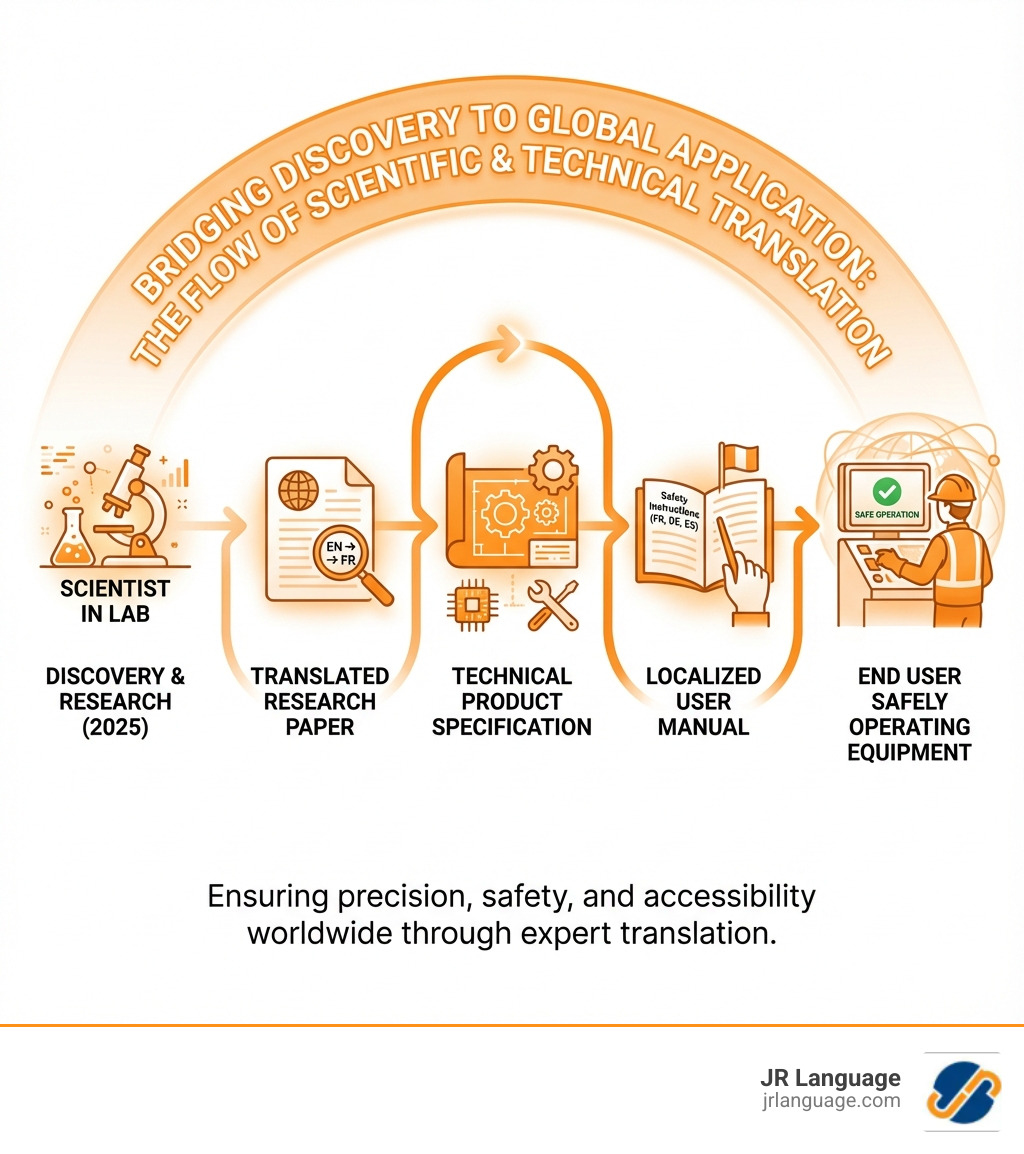
For instance, when translating a research paper on gene therapy, accuracy in scientific terminology is essential for advancing knowledge and enabling international collaboration.
What Is Technical Translation?
While scientific translation focuses on theoretical knowledge, technical translation emphasizes practical application. This service ensures users can safely operate equipment, follow procedures, and implement solutions—regardless of language barriers.
Technical translation characteristics:
Technical translation prioritizes clarity, conciseness, and usability. Common documents include:
- User manuals and instruction guides
- Product specifications and data sheets
- Patent applications and claims
- Engineering drawings and specifications
- Material Safety Data Sheets (MSDS)
- Technical reports and white papers
- Software interfaces and IT documentation
Industries heavily reliant on technical translation services include manufacturing, automotive, information technology, engineering disciplines, medical device manufacturing, and energy sectors.
Consider a medical device manufacturer exporting equipment internationally. The instruction manual must be crystal clear—a mistranslation could lead to equipment malfunction or patient harm. This is where professional technical translation becomes mission-critical.
Key Differences at a Glance
While both scientific and technical translation demand specialized knowledge and linguistic precision, their distinct objectives lead to different approaches and priorities. Here’s a quick comparison to highlight these differences:
| Feature | Scientific Translation | Technical Translation |
|---|---|---|
| Primary Goal | Disseminate theoretical knowledge and research findings | Facilitate practical application, operation, and understanding |
| Target Audience | Academics, researchers, scientists, students | Engineers, technicians, consumers, operators, end-users |
| Common Document Types | Research papers, journal articles, theses, clinical trials, academic textbooks | User manuals, patents, data sheets, product specifications, engineering drawings, and technical reports |
| Key Metric | Conceptual accuracy, precision of scientific terminology, and academic tone | Clarity, conciseness, usability, practical applicability, safety |
The boundaries between scientific and technical translation can sometimes blur, as many fields, like biotechnology, are inherently interdisciplinary. However, understanding the core intent of the original document helps us tailor our approach for optimal results.
Understanding these distinctions enables businesses to select the most suitable translation services for their specific needs.
Three Core Challenges in Specialized Translation
1. Mastering Complex Terminology
Scientific and technical fields contain highly specialized vocabulary that often lacks direct equivalents in other languages. Professional translation services must navigate:
- Domain-specific jargon that varies by industry and context
- Terminology consistency across all documentation
- Neologisms created by rapidly evolving fields
- Polysemous terms where context determines meaning
- Abbreviations with multiple potential interpretations
Unlike general content, where synonyms add variety, precision in specialized translation requires exact and consistent terminology. Translation agencies build extensive glossaries and termbases: customized databases that ensure every translator uses identical terms throughout a project.
2. Ensuring Absolute Accuracy
In scientific and technical translation, mistakes have real consequences. A mistranslated dosage in pharmaceutical documentation could endanger lives. An error in engineering specifications could cause equipment failure. Misinterpreted safety protocols could lead to workplace accidents.
This high-stakes environment demands:
- Subject matter expertise from translators with technical backgrounds
- Meticulous attention to numbers, measurements, and data
- Cultural adaptation to ensure concepts translate appropriately
- Certified translation for regulatory and legal documents
Quality translation services implement rigorous verification processes. Numbers, graphs, charts, and technical diagrams receive the same scrutiny as text, with careful attention to regional formatting standards and units of measurement.
3. Requiring Specialized Expertise
Language fluency alone cannot produce accurate scientific or technical translation. The complexity of specialized content demands translators who are essentially bilingual subject matter experts. Professional translators in these fields typically possess dual qualifications:
- Advanced degrees in relevant technical or scientific disciplines
- Native-level proficiency in target languages
- Years of experience in specialized subject areas
- Continuous professional development to stay current with industry evolution
Many translators working in scientific and technical translation hold master’s degrees or PhDs in fields like engineering, medicine, biotechnology, or chemistry. This deep subject knowledge enables them to comprehend complex concepts, identify potential ambiguities, recognize when terminology may be misused, and make informed translation decisions that preserve both meaning and technical precision.

Consider translating a patent application for a new semiconductor manufacturing process. The translator must understand not just the language, but the underlying physics, engineering principles, and legal implications of every term choice. Similarly, translating clinical trial protocols requires understanding medical terminology, statistical methods, regulatory requirements, and ethical considerations—all while maintaining perfect linguistic accuracy.
Professional translation agencies carefully vet their linguists, verifying both educational credentials and practical experience. Many require translators to pass rigorous tests demonstrating subject matter expertise before assigning them specialized projects. This ensures that your pharmaceutical documentation goes to a translator with pharmaceutical expertise, your automotive manuals to someone with automotive industry knowledge, and your aerospace specifications to a translator who understands aviation engineering.
Translation agencies also collaborate with industry experts and researchers to clarify complex points, validate terminology, and ensure translations align perfectly with field-specific standards and conventions. This interdisciplinary approach guarantees both linguistic excellence and technical accuracy—the dual competence that makes specialized translation truly professional.
Technology and Quality Assurance in Translation Services
Advanced Translation Technologies
Modern professional translation services leverage sophisticated technology to enhance accuracy and efficiency while maintaining the irreplaceable human element:
Computer-Assisted Translation (CAT) Tools: These specialized software platforms provide translators with powerful resources without replacing human expertise. Unlike machine translation, CAT tools assist human translators rather than attempting to replace them. These platforms manage complex projects, maintain consistency across documents, and integrate various linguistic databases seamlessly. For businesses managing ongoing documentation or product updates across multiple languages, CAT tools ensure every iteration maintains perfect consistency with previous versions.
Translation Memory (TM): This intelligent database stores previously translated segments: sentences, phrases, and paragraphs from your company’s past translations. When similar content appears in new projects, the TM suggests the established translation, ensuring consistency in terminology and phrasing across all your documentation. This proves especially valuable for technical manuals with repetitive instructions, product specifications that update periodically, or companies maintaining extensive documentation libraries across multiple languages. Translation memory doesn’t just ensure consistency—it reduces costs for subsequent translations while accelerating delivery timelines.
Terminology Databases and Corpus Resources Professional translators access extensive specialized dictionaries, knowledge banks, and parallel corpora (collections of texts and their translations). These comprehensive resources enable terminology research across multiple sources, ensuring the most precise and appropriate terms are used—even for emerging concepts in rapidly evolving fields like biotechnology or artificial intelligence. Many translation agencies maintain client-specific terminology databases that capture your company’s preferred terms, brand voice, and industry-specific language conventions.
These technologies enable professional translation services to handle large-scale multilingual projects efficiently while maintaining the quality standards that only human expertise combined with advanced tools can deliver.
The result? Faster turnarounds without compromising accuracy.
The TEP Quality Process
Quality assurance in professional translation services follows a rigorous three-step methodology:
- Translation: A qualified subject matter expert translates the document
- Editing: A second independent linguist—also an expert in the field—reviews for accuracy, completeness, terminology adherence, and cultural appropriateness
- Proofreading: A final linguist checks for formatting issues, typos, and overall readability
This multi-layer approach ensures every document meets the highest standards before delivery.
These certifications demonstrate commitment to consistent quality, rigorous processes, and continuous improvement.
Frequently Asked Questions
Which industries need specialized translation the most?
Life sciences and pharmaceuticals, medical devices, all engineering disciplines, software and IT, manufacturing, energy, aerospace, automotive, and environmental science all require precise technical or scientific translation services for global operations.
Why are specialized translation services more expensive?
The investment reflects the high level of expertise required. Translators with advanced technical degrees, extensive industry experience, and dual competence in language and subject matter command appropriate compensation. However, this investment mitigates the far greater costs of errors: product recalls, legal issues, safety incidents, or regulatory non-compliance.
Can machine translation handle technical documents?
While AI-powered machine translation continues improving, it struggles with nuance, context, and domain-specific terminology. For critical documents where accuracy directly impacts safety, regulatory compliance, or scientific validity, professional human translation remains essential. Machine translation with human post-editing may work for lower-risk, repetitive content, but cannot replace expert-led translation for mission-critical materials.
JR Language: Your Partner for Global Communication
In our interconnected world, accurate scientific and technical translation enables innovation to cross borders. Whether disseminating breakthrough research or ensuring the safe operation of equipment globally, professional translation services bridge critical communication gaps.
At JR Language Translation Services, we deliver culturally accurate translations through native-speaking, industry-experienced translators who possess in-depth knowledge of your specialized field. Our commitment to quality means your scientific breakthroughs gain global recognition and your technical innovations are implemented safely across international markets.
Don’t let language barriers limit your global reach or compromise the integrity of vital information. Partner with our experienced translation professionals who understand the stakes and have the expertise to deliver flawless results.


