

The drill string snaps at 3 AM on an offshore platform in the North Sea. Your Norwegian crew needs to consult the Chinese manufacturer’s technical manual—immediately. Your Spanish-speaking safety officer in Venezuela needs to brief the English-speaking regulators on yesterday’s incident. A mistranslated valve specification in your refinery’s operating manual could mean the difference between smooth operations and a catastrophic shutdown.
In the global oil and gas industry, language barriers aren’t just inconvenient—they’re potentially dangerous and expensive. With operations spanning over 120 countries and the industry employing more than 12 million workers worldwide, precise multilingual communication with specialized oil and gas translations has become as critical as the technical specifications themselves.
The Global Energy Landscape Demands Professional Translation Services
The global scale of the oil and gas industry makes professional translation services essential for operations that span continents, languages, and regulatory frameworks. According to the International Energy Agency’s World Energy Investment 2024 report, upstream oil and gas investment reached $570 billion in 2024, representing a 7% increase from the previous year. Nearly 90% of this investment was dedicated to offsetting production declines, rather than meeting new demand growth.
This massive investment flows across borders and languages. Projects in the Middle East require Arabic translations. Operations in Latin America demand Spanish and Portuguese expertise. Asian markets require capabilities from China, Japan, and Korea. North Sea platforms operate with documentation from Norway, the Netherlands, and the United Kingdom. Every contract, every safety manual, every technical specification must work flawlessly across these linguistic boundaries.
“When you’re managing operations across multiple countries and time zones, technical translation services are mission-critical. A mistranslated pressure specification or an unclear safety protocol not only delays a project but also poses risks and endangers lives. This is why we work with industry subject matter experts and conduct a vigorous quality assurance workflow for each oil and gas multilingual translation service project. “ – Sergio Ruffolo, President of JR Language Translation Services.
Why General Translation Services Fail Energy Companies
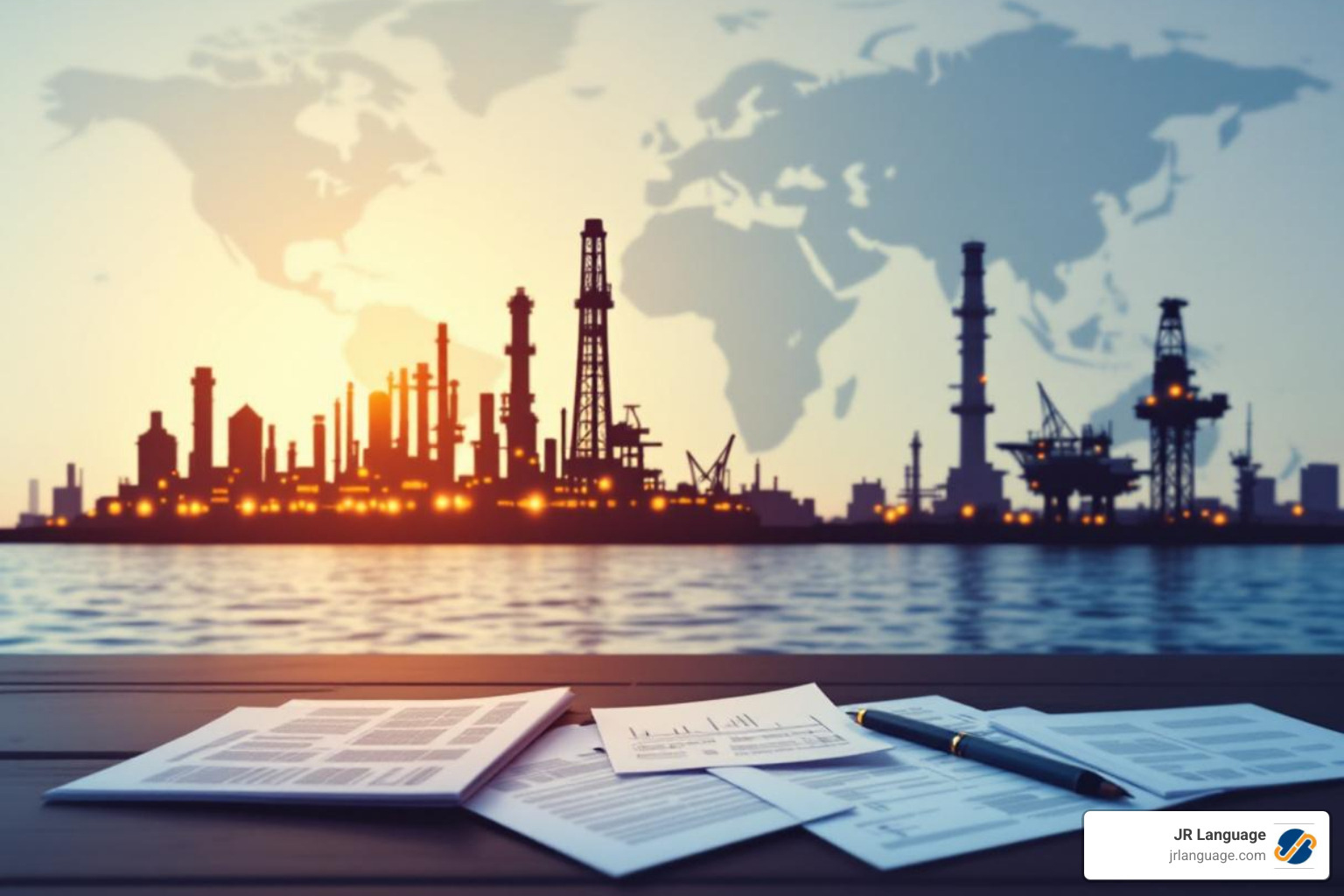
Generic document translation services aren’t equipped to meet the demands of the energy sector. The industry operates with specialized terminology that even experienced linguists without technical backgrounds cannot accurately handle. Consider these challenges:
- Technical terminology is unforgiving: Terms like “fishing” (retrieving equipment from a wellbore), “pigging” (pipeline cleaning), “blow-down” (controlled pressure reduction), and “blow-out” (uncontrolled release) have specific meanings. Confusing them leads to operational failures or safety incidents.
- Regulatory compliance crosses borders: HSE (Health, Safety, and Environment) documentation, environmental impact assessments, and regulatory submissions require not just accuracy but adherence to specific legal frameworks. ISO 14001, OSHA standards, REACH regulations, and local petroleum acts all demand precise translation to maintain compliance.
- Time sensitivity is standard: When a drilling operation encounters an unexpected geological formation or equipment fails on an offshore rig, translated technical guidance isn’t helpful tomorrow—it’s essential now.
- Consequences are measured in millions: According to industry analysis, global oil and gas operations span infrastructure exceeding 3.9 million kilometers of pipelines. A single mistranslation that causes operational downtime can cost hundreds of thousands of dollars per hour in lost production, repair costs, and regulatory penalties.
Documents That Power the Oil, Gas, and Energy Industry
From exploration to distribution, the oil and gas sector generates documentation that requires specialized translation:
- Upstream Operations: Geological surveys, seismic data analyses, drilling procedures, well control protocols, reservoir engineering reports, and exploration contracts all contain highly technical content. When an exploration team in Brazil analyzes seismic data from equipment manufactured in Norway, accurate translation of both the raw data interpretation and the equipment specifications becomes essential.
- Midstream Infrastructure: Pipeline specifications, transportation logistics, storage facility documentation, and midstream contracts coordinate the movement of resources across international boundaries. With LNG trade growing 6.2% year-over-year and major expansion projects in the United States and Qatar set to increase capacity by 50%, the volume of documentation requiring professional translation services continues to accelerate.
- Downstream Processing: Refinery operating manuals, process control documentation, petrochemical production specifications, distribution agreements, and marketing materials reach consumers worldwide. As refiners adopt digital innovations and innovative fuel management systems, the technical translation requirements become increasingly complex.
- Legal and Financial Documentation: Joint venture agreements, procurement contracts, patent filings, financial statements, regulatory submissions, and tender documents all carry legal weight. These materials require not only linguistic accuracy but also an understanding of legal terminology across multiple jurisdictions.
When Your Workforce Speaks Spanish, Your Documentation Must Too
Latin America is experiencing an oil boom that’s reshaping global energy markets. This surge creates an immediate translation challenge: Spanish-speaking operations teams, Portuguese-speaking Brazilian engineers, and English-speaking international partners must coordinate complex technical operations with zero room for miscommunication.
The stakes extend beyond Latin America. According to industry data, Spanish ranks among the top five languages required for global oil and gas operations, alongside English, Arabic, Chinese, and Russian. When your Houston headquarters coordinates with Venezuelan field operations, when your Spanish suppliers provide equipment to North Sea platforms, when your Mexican refineries must comply with US regulatory standards, accurate Spanish translation becomes operational infrastructure.
Professional Spanish translation services for the energy sector require translators who understand both the technical content and regional variations. Mexican petroleum terminology differs from Venezuelan usage, which differs from Spanish operations. The distinction matters when your documentation must work correctly across multiple Spanish-speaking markets simultaneously.
Where AI Meets Human Expertise in Energy Translation
The oil and gas industry is rapidly adopting AI across operations. Translation technology follows a similar trajectory, but with a critical distinction: AI translation tools excel at speed while human expertise ensures accuracy, safety, and compliance. This hybrid approach—often called machine translation post-editing (MTPE)—delivers significant advantages for energy companies:
- Speed for routine documentation: Standard operating procedures, routine maintenance logs, and repetitive technical specifications can move through AI-assisted translation faster than traditional methods alone.
- Consistency at scale: When translating thousands of pages of similar content—think pipeline specifications across a 500-kilometer project—AI ensures terminology remains consistent while human reviewers verify technical accuracy.
- Cost efficiency for appropriate content: Internal communications, preliminary reports, and draft documentation benefit from AI speed without requiring the full human translation investment needed for regulatory submissions.
At JR Language, our AI translation services always include expert human review for energy sector content. We understand that while AI can translate the words in a well-controlled procedure, only a human expert with petroleum engineering knowledge can verify that the translation will keep your crew safe when they need it most.
The Cost of Getting It Wrong
Energy companies face significant operational risks when translation quality falters:
- Safety incidents: Incorrectly translated emergency procedures or equipment operating instructions create immediate danger. When offshore platform crews cannot clearly understand safety protocols, response times slow, and accidents become more likely.
- Regulatory rejection: Denied permits, delayed project approvals, and compliance violations stem directly from mistranslated regulatory submissions.
- Equipment damage: Maintenance manuals and technical specifications that lose critical details in translation lead to improper equipment operation, costly repairs, and extended downtime.
- Project delays: When international consortia struggle to communicate clearly about engineering specifications, procurement requirements, or project timelines, multimillion-dollar projects often fall behind schedule.
JR Language’s Approach to Energy Sector Translation
At JR Language Translation Services, our methodology reflects decades of experience with complex technical content across global operations: We provide culturally correct translations delivered by native, industry-experienced translators who understand oil and gas terminology, safety requirements, and regulatory contexts. Our process includes:
- Specialized translator selection: Every project is matched with linguists who have relevant technical backgrounds, such as petroleum engineers who have transitioned into translation, geologists with language expertise, or safety professionals with multilingual capabilities.
- Rigorous verification: Multiple reviewers examine each translation for technical accuracy, regulatory compliance, and linguistic precision. We verify that pressure ratings, temperature specifications, chemical compositions, and safety protocols are accurately translated.
- Terminology management: We create custom glossaries tailored to each client, ensuring that your company’s specific terminology, product names, and technical specifications remain consistent across all translations.
- Comprehensive service offering: From certified translation services for visa applications and legal proceedings to technical translation services for engineering documentation, we cater to the full spectrum of language needs in the energy sector.
Our commitment extends across all energy translation requirements: legal translation services for contracts and regulatory submissions, financial translation services for investor communications and compliance reporting, and multilingual translation services that support operations in over 100 languages.
Move Forward with Our Energy Translation Services for Your Global Oil and Gas Industry Projects
The oil and gas industry’s international nature isn’t changing. As exploration pushes into new territories and as international partnerships deepen, the volume and complexity of multilingual documentation will only grow.
Success in this environment requires translation partners who understand that energy sector documents aren’t just text to be converted. They’re technical specifications that must work correctly in every language, safety protocols that must protect workers regardless of what language they speak, and regulatory submissions that must satisfy authorities across multiple jurisdictions.
At JR Language, we recognize that professional translation services for the energy sector represent a strategic capability, not just a support function. When your operations span continents, when your teams speak different languages, when your documentation must maintain its technical precision across linguistic boundaries, specialized translation becomes infrastructure. Contact us to discuss your energy sector translation needs and discover how industry-specific expertise makes the difference in keeping operations running safely and compliantly worldwide.


