

When a Texas-based mid-sized construction firm landed its first major project in São Paulo, it was time for celebration. And yet, they knew there was still a long way to go. They first needed to coordinate 47 subcontractors speaking six different languages. Three months in, they’d figured it out.
The key was treating the communication infrastructure the same way they’d approach any mission-critical system. They made professional translation services part of the project backbone. Today, they’re managing builds across four continents, and their investment in construction translation services has become a genuine competitive edge.
The numbers tell the story: the global construction market hit $11.39 trillion in 2024 and is projected to reach $16.11 trillion by 2030. Companies mastering international project communication are capturing opportunities that domestic-only competitors simply can’t access.
“The construction industry is globalizing faster than ever, and companies need multilingual translation services more than ever. Our job is to ensure that an architect in Toronto, an engineer in Buenos Aires, and a contractor in Miami are all working from the exact same understanding of what needs to be built.” – Sergio Ruffolo, President, JR Language Translation Services
The Workforce Reality Reshaping Construction
Construction has turned into an industry with a diverse workforce, even on domestic projects. Walk onto major sites in Houston, Miami, Toronto, or Los Angeles, and multilingual crews are standard practice.
Don’t think of it as a challenge to overcome. Rather, think of it as a resource to tap into. Don’t just have your worker safety manuals in English. Make these available in all the languages relevant to your workforce. Make use of our technical manual translation services so everyone is on the same page.
The firms winning international contracts understand something fundamental: workforce diversity mirrors the global markets they’re trying to enter.
What This Means for Project Leaders
The real issue isn’t just “language barriers.” Construction operates on razor-thin tolerances where millimeters matter. A measurement conversion mistake or misunderstood specification can compromise structural integrity. When your steel fabricator in Mexico interprets plans differently than your structural engineer in Chicago intended, you’re facing more than rework—you’re looking at safety exposure.
Technical precision is non-negotiable
One misread tolerance in a load calculation affects everything downstream. The difference between 5/8″ and 5/8 cm isn’t trivial when it’s a structural element.
Cultural context shapes how instructions land
The same directive translated into different languages can mean very different things depending on cultural norms around communication. Direct versus indirect styles, hierarchical versus collaborative decision-making—these patterns vary significantly across cultures and affect how teams execute work.
Regulatory language doesn’t approximate well
OSHA standards, CE markings, and local building codes use specific terminology that can’t be loosely interpreted. A “code-compliant” guardrail means different things in different jurisdictions, and imprecise translation creates real liability exposure.
Real-time coordination determines schedule performance
When your morning safety briefing needs to reach everyone clearly, when an RFI requires immediate clarification, and when site conditions change, the entire team needs to pivot. That’s when communication infrastructure proves its value.
Why Some Companies Win International Contracts While Others Don’t
The construction firms landing projects in the Middle East, Latin America, and Asia-Pacific aren’t necessarily the largest. They’re the ones demonstrating operational maturity that international clients recognize.
Sophisticated buyers evaluate far more than price and timeline. They’re looking for evidence that you can coordinate across borders. They need to feel confident that communication gaps won’t derail schedules. They must feel you respect local language and culture.
Submitting a bid run without taking advantage of professional language services signals you’re not serious about their market.
The Strategic Advantage
Forward-thinking construction companies use technical translation services strategically to:
- Submit proposals adapted to local regulatory frameworks and cultural expectations
- Build credibility and trust with international clients through attention to detail
- Enable seamless coordination between design teams, contractors, and local authorities
- Reduce risk exposure by ensuring compliance documentation is legally precise
- Position themselves as viable players in high-growth international markets
What Actually Needs Translation on International Projects
First-time international project managers typically underestimate the communication volume. Here’s what experienced global construction leaders have learned:
Before Breaking Ground
- Bid and proposal documents adapted to local business customs and regulatory expectations
- Contract negotiations that require legal precision to avoid dispute risk down the line
- Permits and regulatory submissions where errors delay your entire schedule
During Construction
Technical drawings and specifications must maintain engineering intent across languages:
- Structural load calculations
- Material specifications and grades
- Assembly sequences and tolerances
- Quality control checkpoints
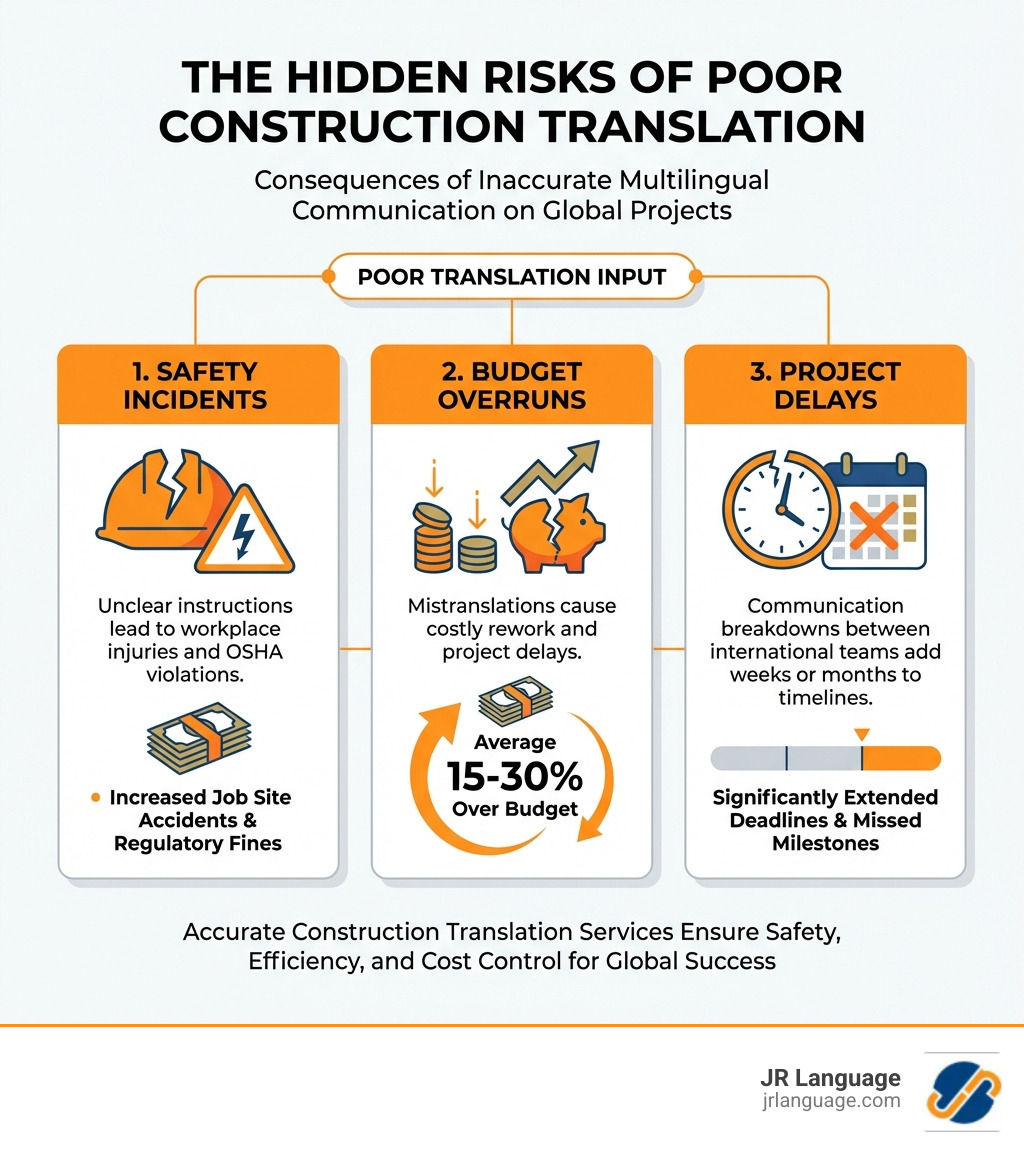
Safety documentation is where the stakes are highest. Language barriers contribute to 25% of on-the-job accidents. With technical manual translations, you ensure equipment procedures, emergency protocols, and hazard assessments are clearly understood by every worker on site.
Daily coordination through morning briefings, RFIs, and change orders is where multilingual translation services prevent small misunderstandings from compounding into major delays.
Why Construction Translation Requires Specialists
You may miss critical nuances that construction professionals recognize immediately:
Terminology depends heavily on context
“Cold joint” in concrete work, “bearing capacity” in structural engineering, “flashing detail” in weatherproofing—these terms carry precise meanings that generic translation tools consistently misinterpret.
With construction projects increasingly incorporating prefabricated components and modular systems, manufacturing translation specialists have become relevant for factory-produced elements, shop drawings, and equipment specifications.
Standards vary significantly by jurisdiction
Building codes aren’t universal. Translators and interpreters need to understand not just language but also the regulatory frameworks governing construction in each market.
Cultural and technical context both matter
How you describe construction sequences, quality expectations, and safety protocols needs to account for both linguistic accuracy and cultural communication patterns that shape how people interpret and act on instructions.
How to Evaluate Translation Partners for Construction Work
You’re not buying a commodity service here. With JR Language Translation Services, you are selecting a language access partner who’ll handle documents directly impacting safety, quality, and legal exposure.
Critical Questions to Ask Your Translation Service Provider
Do your translators have construction industry experience?
Look for linguists with engineering backgrounds or actual construction project experience:
- We understand the difference between structural and architectural drawings.
- Our translators know what BIM data requires for localization.
- Our industry experts are familiar with construction administration processes.
How do you maintain consistency across large document sets?
Construction projects generate thousands of interconnected pages. Terms defined one way in specifications need to match exactly how they’re used in drawings, contracts, and safety manuals. Our project management team works with translation memory systems, project-specific glossaries, and robust quality assurance processes.
What’s your technical accuracy verification process?
Single-pass translation isn’t sufficient for construction documents. At our construction translation agency, we go through multiple review stages:
- Initial translation by a native speaker with construction expertise
- Technical review by a bilingual engineer or construction professional
- Linguistic editing for clarity and precision
- Final formatting check for complex layouts and technical drawings
Building Communication Infrastructure for Global Growth
Successful international construction firms treat multilingual capability as a core competency, not something to outsource and forget about. To get started:
- Create translation-friendly documentation templates with clear structure and consistent terminology from the start
- Develop project glossaries early in the design phase to maintain consistency throughout execution
- Build relationships with specialized providers before urgent needs arise
- Integrate translation into project timelines as you would any critical milestone
What Leading Firms Are Doing
Forward-thinking construction companies are
- Including multilingual capability in bid differentiators to demonstrate operational maturity to international clients
- Providing safety training in workers’ native languages as standard practice, not just a compliance checkbox
- Investing in interpretation services for critical coordination meetings to ensure actual alignment, not just surface-level understanding
- Treating document translation as a quality control checkpoint that often catches ambiguities or errors in source documents before they cause problems
Understanding the Real Costs of Communication Gaps
When construction companies cut corners on communication, the consequences compound quickly:
- Safety incidents from misunderstood procedures lead to OSHA violations
- Rework and delays from misinterpreted specifications—like concrete pours not meeting strength requirements—cost exponentially more than translation services
- Legal disputes from ambiguous contract language create expensive, protracted litigation
- Lost competitive opportunities when bids don’t demonstrate the operational maturity international clients expect
- Reputation damage in markets where word spreads quickly about companies that can’t coordinate effectively
Positioning for International Growth
Construction’s global expansion continues to accelerate. Growth in Asia-Pacific, the Middle East, and Latin America creates opportunities that domestic-only firms can’t capture. Companies succeeding in these markets recognize that multilingual communication isn’t overhead. It is infrastructure that enables growth.
JR Language Translation Services works with construction companies managing projects across continents. Our native, industry-experienced linguists handle technical documentation with the precision these projects demand. We cover everything from bid documents and contracts to blueprints, specifications, and safety manuals.
Ready to strengthen your global project capabilities? Get a free quote for your construction translation needs.


