

Accurate legal translation protects your rights. It brings clarity. It ensures compliance across borders. When every word matters, precision isn’t optional. That’s where professional translation services help.
German legal documents need special care. The terminology is highly specific. A small mistranslation can change the meaning of a contract, court ruling, or regulatory filing. German translation services by JR Language legal translation experts make sure your documents are correct in both language and law. We bridge the two systems with accuracy and confidence.
Why German Legal Translation Demands Expert Precision
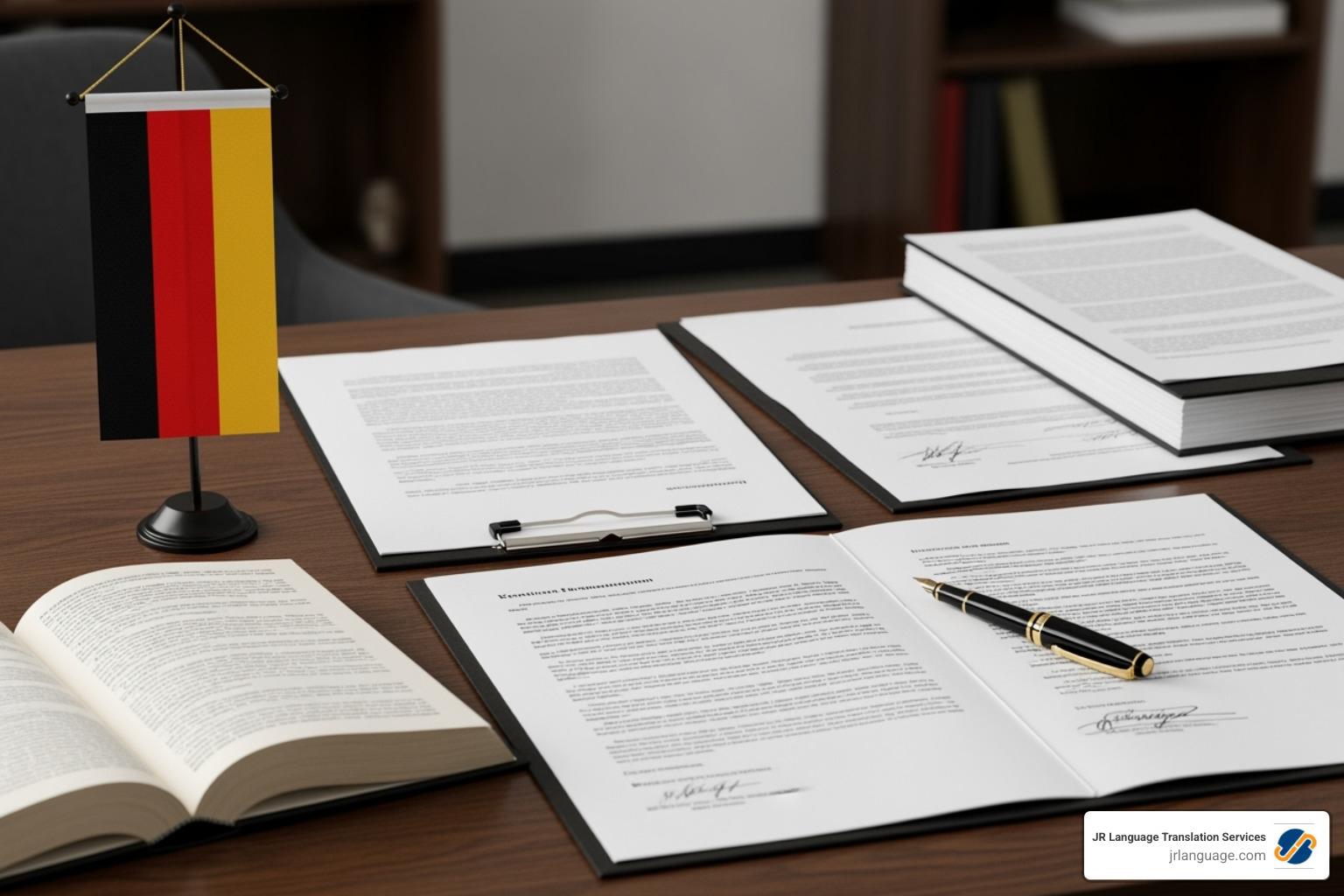
A German legal translator is a specialized professional. They have expertise in translating documents related to all matters of the law between German and English. Our experts take care of legal accuracy and cultural context.
Speaking a language fluently isn’t enough. One wrong term in a legal translation can invalidate an agreement. You could lose a court case. This field sits at a tricky intersection. German civil law meets English common law. Add linguistic challenges like compound words and legal concepts with no direct match. According to recent research on legal translation challenges, translating legal texts requires more than fluency in both languages. You also need a deep understanding of the legal systems, terminology, and cultural contexts.
Working with a professional legal translation agency like JR Language protects you. The stakes are too high to guess.
Why German Legal Translation is a High-Stakes Specialty
Being fluent in German doesn’t make you a legal translator. This specialty bridges two different legal worlds. German civil law and English common law work differently. “Close enough” is never acceptable.
The German language itself adds complexity. Long compound words like Schadenersatzpflicht (“damage-compensation-obligation”) carry specific legal weight. The difference between formal “Sie” and informal “du” can change the legal relationship between parties. German legal sentences are often long and complex. A translator must untangle the grammar while keeping every detail.
The consequences of errors are severe. Invalidated contracts. Lost court cases. Damaged business reputations. One company’s poorly translated employment contract led to a legal battle costing hundreds of thousands. That’s far more than hiring a professional would have cost.
The Critical Difference: German vs. English Legal Systems
We’re not just translating terms. We have to translate keeping in mind the different ways of thinking. This applies to differences in both the languages and the laws.
Take “GmbH” (Gesellschaft mit beschränkter Haftung), often translated as “LLC.” But a GmbH requires €25,000 minimum capital and specific notarization. An LLC doesn’t. “Schadenersatz” (damages) is calculated differently in each system. A translator must preserve these legal implications.
Here’s the most significant divide: Common law relies on judicial precedent. Courts look to past cases. German civil law relies on codified statutes. This makes German contracts more exhaustive. They spell out everything because they can’t depend on courts “filling in the gaps.” A skilled translator knows when direct translation works and when you need additional context.
Common Documents Requiring a German Legal Translator
Many documents require a professional legal translator, often with certification for official use.
- Contracts and Agreements: Employment, sales, licensing, and non-disclosure agreements. Precise contract translation services are essential.
- Court Orders and Judgments: For international litigation and enforcement.
- Patents and IP Documents: Requires both legal and technical translation expertise. Look for a translation company that offers patent translation services.
- Personal Documents: Birth/marriage certificates and death certificates for immigration or official matters, often needing certified translation services.
- Wills and Testaments: For cross-border estate planning.
- Corporate Documents: Articles of incorporation and bylaws for international expansion.
- Affidavits and Sworn Statements: For court proceedings.
- Legislation and Regulations: For compliance and international cooperation, sometimes requiring technical translation services as well.
For any document submitted to a government agency or court, certification is usually mandatory. This gives the translation legal standing. Partner with us at JR Language Translation Services. We know these requirements well.
The Hallmarks of a Qualified German Legal Translator
A qualified German legal translator has a rare combination of skills. It goes beyond being bilingual. At our legal translation agency, we look for several key traits:

- Native Fluency in the Target Language: This is the starting point. A native speaker instinctively understands the nuances of legal phrasing in their culture.
- Verifiable Legal Expertise: The best translators understand the law itself. Many are former lawyers or paralegals. This expertise is what distinguishes professional legal translation services from general providers.
- Subject Matter Specialization: A translator excelling in corporate law may not be suited for patent law. We match translators to projects based on their specific legal specialty.
- Professional Certifications: Credentials from rigorous examination bodies provide external validation of a translator’s competence.
- Years of Experience: A seasoned translator has developed instincts about where errors hide in complex legal documents. This judgment is invaluable, which is why an established translation services company provides peace of mind.
Understanding German vs. English-Speaking Certifications
The term “certified” means different things in Germany and English-speaking countries.
- Sworn Translators in Germany: Known as “vereidigte Übersetzer.” These professionals are officially appointed by a German court. They take an oath. Their stamp and signature carry legal authority. This makes their translations valid for German courts and government offices. You can verify their status in official databases, such as the Dolmetscher- und Übersetzerdatenbank.
- Certified Translators in English-speaking Countries: In the U.S., UK, or Canada, there is no government appointment system. “Certified” usually means the translator or translation company provides a signed “certificate of accuracy.” Professional bodies like the American Translators Association (ATA) also offer certifications. Sometimes, this certificate must be notarized. This means a Notary Public verifies the signer’s identity. Not the translation’s quality.
Always confirm the specific certification requirements with the receiving authority. If live interpretation is needed for court proceedings, we will connect you to our expert German interpreters.
Your Step-by-Step Guide to Vetting and Hiring an Expert
Hiring a German legal translator requires the same diligence as hiring a lawyer. A structured vetting process ensures you find an expert who can protect your interests.

First, define your needs: What is the document type? Who is the audience? What are the certification requirements (e.g., sworn for German courts, certified for U.S. immigration)?
Next, follow these steps:
- Seek Specialized Legal Expertise: Look for proven experience with your specific document type, whether it’s contract law or intellectual property.
- Ask Targeted Questions: Inquire about their understanding of German civil law vs. common law and their experience with similar documents.
- Request Redacted Work Samples: Reputable translators can provide samples of past work with confidential information removed.
- Check References: Speak with past clients, especially those with similar legal needs.
- Confirm Confidentiality Protocols: Ensure they have robust data security measures and are willing to sign a Non-Disclosure Agreement (NDA). Professional translation services have these protocols in place.
- Understand Their Quality Assurance Process: A multi-step process involving translation, editing, and proofreading (TEP) is superior to a single translator’s self-review.
JR Language: Ensure Legal Translation Accuracy with German Translation Services
German legal translation is a high-stakes field. Precision is paramount. The complexities of bridging German civil law and English common law are real. Add linguistic challenges. Only a qualified professional can ensure your documents are legally sound.
For complex or high-volume projects, JR Language offers the best value. We provide dedicated project management. A multi-step quality assurance process. The ability to scale for multilingual translations. Our legal translation agency provides the infrastructure necessary to manage risk and ensure accuracy. An invalidated contract or a lost court case costs far more than investing in professional translation.
Ready to ensure your German legal documents are accurate and compliant? Request a free quote today and connect with our team of specialized German translators.


