

You’ve built a strong digital presence: clear messaging, solid UX, good content. But if it only exists in English, you’re invisible to a massive, high-intent audience that’s actively looking for what you offer.
The good news is that Spanish website localization isn’t just an expense. Done right, it’s a growth lever. And professional translation services are what make the difference between a Spanish site that converts and one that just exists.
Spanish Website Localization vs. Translation: They’re Not the Same Thing
This distinction matters before anything else, because it shapes your entire strategy.
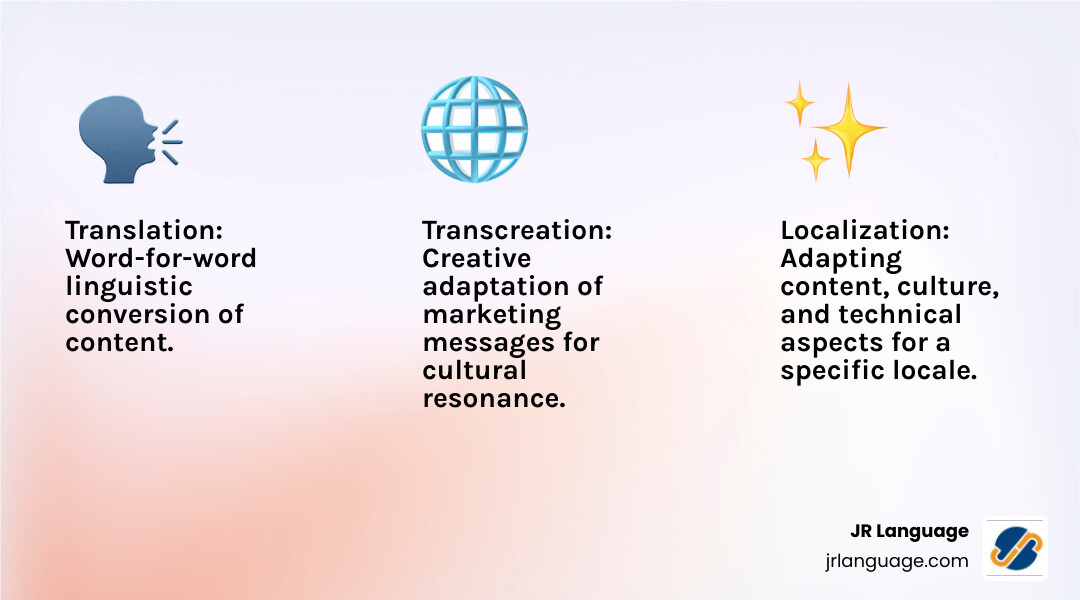
Spanish translation services convert text from Spanish to English or vice versa – or any other language. It’s necessary, but it’s only the foundation. A direct translation of your homepage might be linguistically correct and still feel completely off to a native Spanish speaker—wrong tone, awkward phrasing, culturally misaligned references.
Language localization goes further. It adapts everything: the language, the cultural context, the visuals, the user experience. It’s the difference between content that reads like it was translated and content that reads like it was written for that audience from the start.

What You Need For Your Website
For a Spanish-language website, that means making decisions about formality, regional vocabulary, imagery, idioms, date and currency formats, and even how calls to action are phrased. A button that says “Get Started” in English might land very differently depending on whether your audience is in Mexico City, Miami, or Buenos Aires.
Transcreation services take this a step further for marketing content—it’s a creative rewrite that preserves intent, emotional tone, and persuasive power, rather than just rendering words. If you have taglines, campaign copy, or brand voice elements that need to carry their punch across languages, transcreation is the right tool.
At JR Language, we work with you to determine what each piece of content actually requires—translation, localization, or transcreation—so your budget goes where it creates the most impact.
The First Decision: Which Spanish?
Spanish is spoken across more than 20 countries, and regional differences aren’t just cosmetic. Vocabulary, formality conventions, and even grammar can vary enough to signal “outsider” to a native speaker if you get it wrong.
The three main scenarios you’ll navigate:
- Targeting the U.S. Hispanic market is its own distinct case. This audience often spans multiple Latin American backgrounds, with some English code-switching common in everyday speech. A neutral Latin American Spanish—clear, warm, and avoiding highly regional slang—tends to work well here. Cities like Houston, Los Angeles, Miami, and New York each have their own demographic textures, which can matter for hyperlocal campaigns.
- Targeting Latin America means deciding whether to use a pan-regional neutral Spanish or to localize per country. For broad campaigns, a carefully neutral approach works. For country-specific pages or highly localized marketing, a native linguist from that country makes a meaningful difference.
- Targeting Spain uses different vocabulary in key areas (the classic example: “ordenador” in Spain vs. “computadora” in Latin America), a different grammatical register with “vosotros,” and a distinct cultural frame for everything from humor to formality.
Our native linguists help you choose the right variant, or build a strategy across multiple dialects, based on where your actual customers are.
Multilingual SEO: Your Spanish Site Won’t Rank by Accident
One of the most common mistakes businesses make with website localization is treating SEO as an afterthought. You can have a beautifully localized Spanish site and still be completely invisible in Spanish-language search if the technical and content SEO work isn’t done properly.
Keywords Don’t Just Translate
Your English keyword strategy doesn’t map directly to Spanish. The terms Spanish speakers use to search for your products or services may be entirely different—shaped by regional vocabulary, search behavior, and how your industry talks about itself in different countries. Effective multilingual SEO requires native-language keyword research, not just translation of your existing keyword list.
Technical SEO for Spanish Pages
The technical foundation matters:
Hreflang tags tell search engines which version of your page to serve to which audience. Without them, your Spanish and English pages may compete with each other in search results, or the wrong version may rank in the wrong market.
URL structure is a strategic choice: a subdomain (es.yoursite.com), a subdirectory (yoursite.com/es/), or a country-code top-level domain (yoursite.es) each have different implications for SEO authority and maintenance. We’ll walk you through the tradeoffs based on your setup.
Content That Ranks in Spanish
Beyond keywords, your meta descriptions, page titles, alt text, and on-page copy all need to be written for Spanish-language search, not just rendered from English. This is where the combination of Spanish translation services and SEO expertise creates real organic value.
Quality Assurance: More Than Proofreading
A localized website has more ways to go wrong than a translated document—because text lives inside a design, interacts with forms and navigation, and gets rendered differently across devices.
At JR Language, our QA process for website localization covers:
Linguistic review by a native speaker for grammar, tone, consistency, and brand alignment. Cosmetic QA to catch layout issues that Spanish text creates when it runs longer than English—truncated buttons, broken headings, spacing problems. Functional testing of links, forms, menus, and language switchers in the localized environment. And in-context review of the actual rendered pages, where issues that don’t appear in a standalone document become visible.
This layered review is what keeps your Spanish site looking and functioning as intentionally as your English one.
Ready to Reach the Spanish-Speaking Market?
Spanish website localization isn’t a translation project. It’s a market entry strategy, a brand expression, and a conversion investment—all at once.
At JR Language Translation Services, we’ve spent over two decades helping organizations build multilingual digital presences that actually perform. Our native Spanish linguists cover the full range of regional dialects, and our localization workflow integrates linguistic quality, cultural accuracy, and technical precision from start to finish.
Request a free quote and tell us about your target market. We’ll help you build a Spanish site that doesn’t just exist—it converts.


