

How Precision in Financial Communication Opens International Markets
When a multinational bank prepares regulatory filings for foreign markets, or a fintech startup launches in new countries, one factor determines success or failure: the accuracy of their financial translation. A single mistranslated term, such as “liquidity,” “adverse action notice,” or “quantitative easing,” can trigger compliance violations, confuse investors, or derail million-dollar transactions.
The global financial services market reached $36.13 trillion in 2025 and is expected to continue expanding at a rate of 7% annually, while cross-border payment transactions approached one quadrillion dollars in 2024, according to the International Monetary Fund. This explosive growth creates unprecedented demand for professional translation services that can navigate complex regulatory frameworks, specialized terminology, and cultural nuances across borders.
Why Financial Translation Demands Specialized Expertise
Financial document translation services convert critical documents, such as annual reports, prospectuses, loan agreements, and insurance policies, from one language to another, maintaining absolute precision in terminology, regulatory compliance, and cultural context. Unlike general translation, this specialized work carries extraordinarily high stakes.
Consider the consequences of inaccuracy: regulatory penalties, investor lawsuits, failed audits, reputational damage, or rejected submissions that cause costly delays. When financial documents inform decisions involving significant capital, every word matters. The challenge intensifies because a single financial term often has multiple equivalents depending on regional practices, and regulatory standards vary dramatically across jurisdictions.
What makes financial document translation uniquely challenging:
- Specialized terminology that changes meaning based on context and geography
- Regulatory complexity across different accounting standards (GAAP, IFRS) and jurisdictions
- High-stakes accuracy where errors can trigger legal penalties or financial losses
- Confidentiality requirements for sensitive proprietary information
- Cultural adaptation beyond literal translation to resonate with local markets
Professional multilingual translations for financial services address these challenges through translators who possess dual expertise: a deep understanding of financial knowledge combined with native-level linguistic proficiency.
Essential Benefits for Global Business Operations
Risk Mitigation and Compliance
Professional translation and interpretation services prevent the costly errors that arise when financial information gets misinterpreted across languages. Whether you’re communicating with international investors, banking regulators, or cross-border partners, accurate translation builds trust and ensures regulatory compliance. Companies can avoid penalties, submission rejections, and the reputational damage that stems from miscommunication.
Market Expansion Support
For businesses entering new markets, language barriers represent a significant obstacle. Financial translation services overcome these barriers, enabling clear communication of investment opportunities, banking products, insurance policies, and fintech applications to global audiences. This linguistic bridge facilitates international growth, partnerships, and access to capital.
Operational Confidence
By ensuring that financial information is accurately conveyed and culturally appropriate, professional language support helps maintain a brand’s reputation across diverse markets. Organizations gain confidence operating anywhere, knowing their financial communications meet both linguistic and regulatory standards.
What Documents Require Financial Translation?
The scope of financial documents requiring translation spans the entire industry:
Corporate Finance:
- Annual and quarterly reports
- Shareholder communications
- Audit reports and financial statements
- Cash flow and income statements
Banking and Lending:
- Loan agreements and credit contracts
- Bank statement translations and account documentation
- International cash management materials
- Foreign exchange documentation
Investment and Securities:
- Investment prospectuses
- Fund documentation and performance reports
- Merger and acquisition materials
- Securities disclosures
Insurance:
- Policy documents and contract terms
- Claims documentation
- Educational materials for policyholders
- Regulatory compliance filings
Fintech and Digital Finance:
- Digital wallet interfaces and applications
- Blockchain and cryptocurrency content
- AI-powered financial tools
- Payment platform localization
Each document type demands specialized knowledge of its purpose, regulatory context, and technical requirements. A prospectus for international investors requires different treatment than an insurance policy for local consumers, even when translating between the same language pairs.
Selecting the Right Translation Partner
Translator Qualifications Matter Most
Look for financial linguists with dual expertise—not just language proficiency, but actual professional backgrounds in finance. The best translation providers employ linguists who have worked as accountants, financial auditors, controllers, bankers, or investment professionals. This combination ensures documents are both linguistically accurate and technically precise.
Many qualified financial translators hold advanced degrees in finance, accounting, or business administration, in addition to translation credentials. They understand financial concepts, instruments, and regulatory frameworks. This knowledge proves essential when terminology nuances or regional accounting practices affect the meaning.
Security and Confidentiality Protocols
Financial documents contain highly sensitive information requiring robust protection. Reputable professional translation services implement comprehensive security measures:
- Signed Non-Disclosure Agreements (NDAs) with all staff and freelance translators
- Encrypted platforms for file transfer and storage
- Strict access controls limiting document visibility to authorized personnel only
- Compliance with data protection regulations, including GDPR and regional requirements
Before engaging a provider, verify their security protocols and certifications. The investment in proper data protection far exceeds the cost of potential breaches.
Quality Assurance and Process
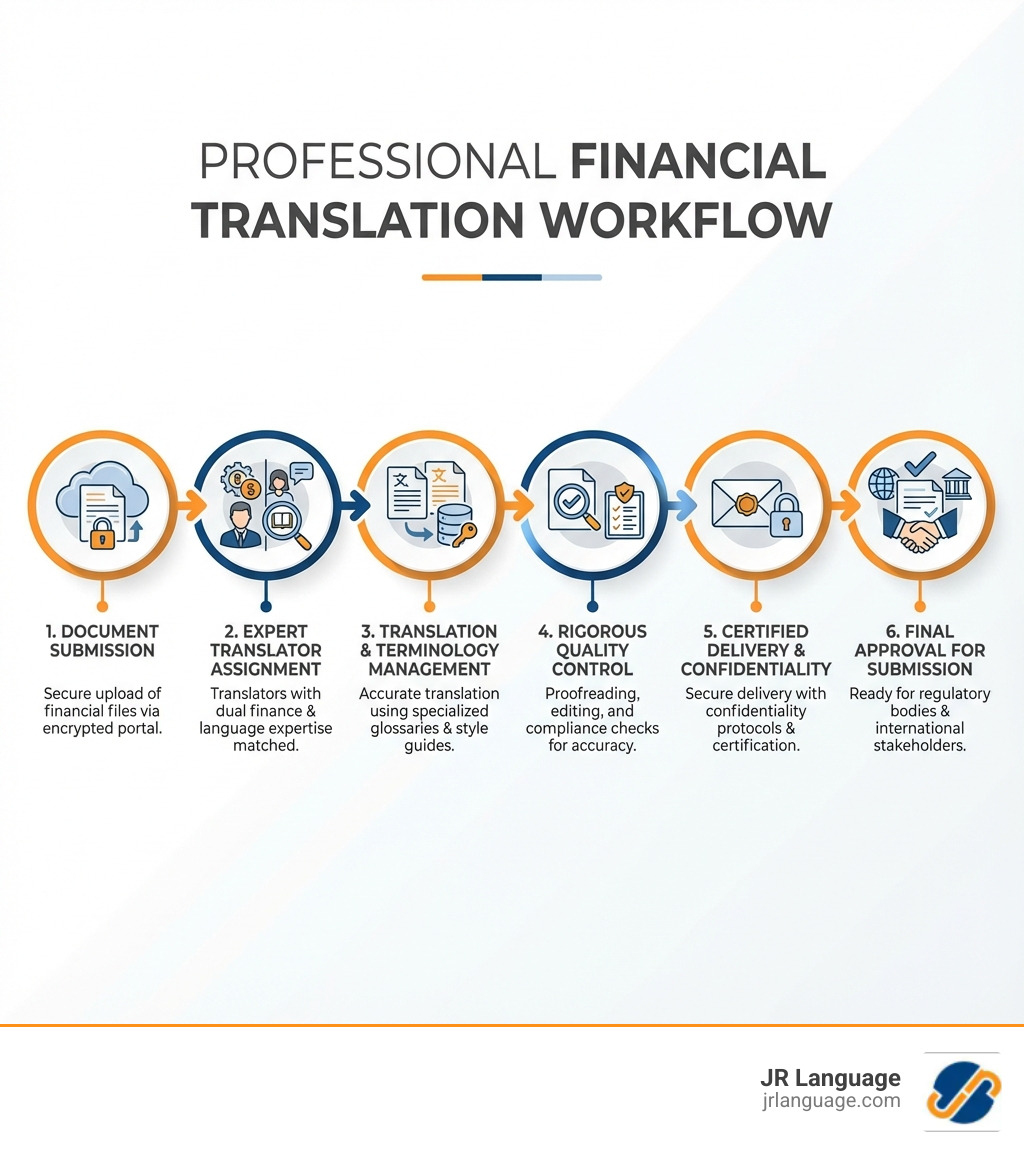
Professional financial translation follows rigorous multi-step workflows. The industry-standard Translation, Editing, and Proofreading (TEP) process ensures accuracy:
- Translation by a qualified financial expert in the target language
- Editing by a second independent linguist who verifies accuracy, terminology consistency, and regulatory compliance
- Proofreading for formatting, final accuracy checks, and readability
Technology and Efficiency
Modern translation agencies leverage Computer-Assisted Translation (CAT) tools—not machine translation, but software that helps human translators work more consistently and efficiently. These platforms enable:
Translation Memory (TM): Databases storing previously translated segments ensure consistency across all documents and projects. When you update financial reports quarterly, TM ensures terminology remains identical across versions.
Terminology Management: Centralized glossaries ensure consistency for industry-specific terms, such as “liquidity” or “adverse action notice,” across multiple translators and projects. This proves critical for large organizations with extensive documentation.
These technologies reduce costs on repetitive content, accelerate turnaround times, and ensure consistency—while human expertise guarantees accuracy that automated systems cannot provide.
Certified vs. Standard Translation: Know the Difference
Understanding which type of translation you need prevents costly mistakes and delays.
Certified Translation Services:
Certified translations include a signed attestation from the translator or agency confirming accuracy and completeness. This formal certification is typically required for:
- Regulatory submissions to government agencies
- Court filings and legal proceedings
- Immigration documentation
- Official banking and lending applications
- International business agreements requiring legal recognition
Financial institutions, regulatory bodies, and legal entities often mandate certified translations to ensure compliance and legal validity.
Standard Translation:
Standard translation, while maintaining professional accuracy and industry expertise, doesn’t include formal certification. Use standard translation for:
- Internal financial reports and communications
- Marketing materials and presentations
- Market research and analysis
- General business correspondence
Both types demand precision, but certified translation adds the legal attestation necessary for official use.
The Critical Role of Localization
Effective financial translation extends beyond word-for-word conversion. Localization adapts content to resonate culturally and functionally with target audiences.
Key localization considerations:
- Numerical formatting: Decimal separators, thousands separators, and currency notation vary by region
- Date formats: Different countries use different standards (MM/DD/YYYY vs. DD/MM/YYYY)
- Cultural context: Idiomatic expressions and financial concepts that work in one culture may confuse in another
- Regulatory alignment: Local terminology and reporting standards that match target market requirements
For example, a figure representing a positive balance in one region might be misinterpreted in another due to different formatting conventions. Professional financial translation services ensure every detail, from numbers to terminology, aligns with local standards and expectations.
“We use advanced translation memory and terminology management tools to enhance efficiency and consistency, but every financial document is reviewed by professionals who understand both the language and the financial implications. That human expertise is non-negotiable when accuracy affects compliance and capital.” – Jacqueline Ruffolo, Founder, JR Language Translation Services
JR Language: Let Us Assist You With Your Global Financial Success
As global financial services continue expanding—with cross-border transactions approaching unprecedented scale—the demand for accurate, compliant financial translation has never been higher. Whether you’re a Fortune 500 institution expanding internationally or a fintech startup launching in new markets, precision in financial communication has a direct impact on your success.
At JR Language Translation Services, we deliver this precision through native-speaking financial experts who possess a deep understanding of both language and finance. From annual reports and prospectuses to loan agreements and fintech applications, we handle the full spectrum of financial documents with the confidentiality, accuracy, and cultural insight your global operations demand.

