

A California-based biotech company developed breakthrough CRISPR gene-editing technology for rare genetic disorders. The science was revolutionary. The market opportunity was enormous. And the clock was ticking on their patent priority date.
They needed protection in the U.S., Europe, China, Japan, and eight other jurisdictions — each with different language requirements, formatting standards, and examiner expectations. Miss a deadline or file an inconsistent translation, and they’d lose protection in entire markets.
Patent Filings: Professional Translators to the Rescue!
Their IP team partnered with professional translation services that understood both the molecular biology and the legal nuances. Native-speaking translators with life sciences expertise handled technical terminology. Multi-stage review ensured consistency across all 47 filings. Every claim was precisely rendered. Every deadline was met.
The result: full patent protection secured across 12 countries within 18 months, with zero examiner objections related to translation quality. Their competitive moat held. Licensing negotiations moved forward without delays. Their market position stayed protected.
That outcome doesn’t happen by accident.
Why You Need Specialized Translation Services
Today’s innovators filed 3.7 million patent applications globally, with approximately 1 million non-resident filings requiring cross-border protection.
When you’re protecting innovation across jurisdictions — from USPTO to EPO to CNIPA — accurate patent translation isn’t a support function. It’s the difference between enforceable protection and expensive rewrites.
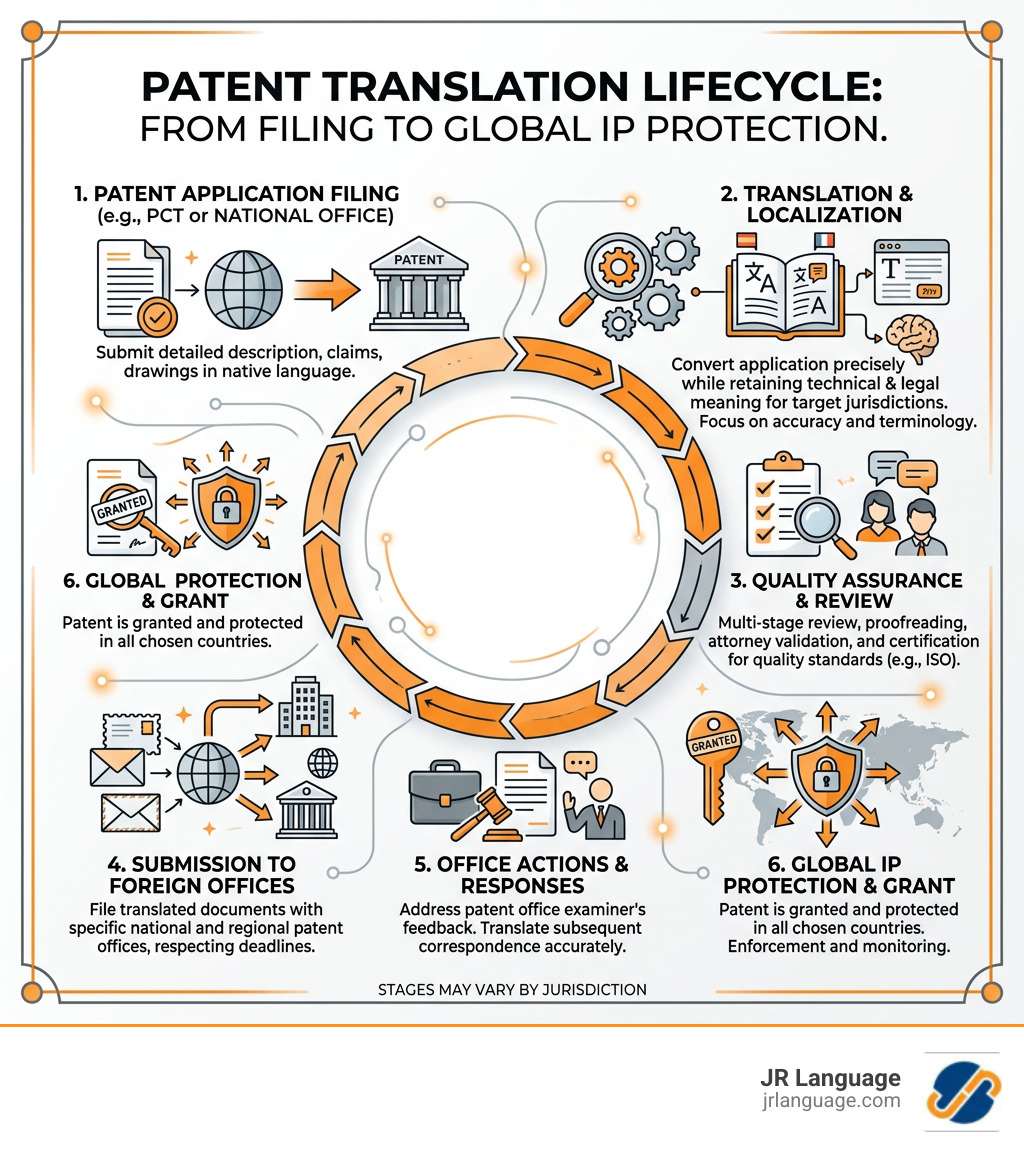
Patent Translation Isn’t Like Other Legal Translation
Patent documents demand a unique combination of technical precision and legal exactitude that generic technical translations or legal translation services can’t reliably deliver.
Here’s what makes IP translation genuinely different.
The Triple Expertise Requirement
Your translator needs to understand the science (engineering, biotech, chemistry), the law (patent office requirements, claim construction), and both languages at a native level. A skilled general legal translator might handle the terminology in contract translations fluently and fail completely on quantum computing architecture. These are not interchangeable skill sets.
Claims Define Your Competitive Moat
Patent claims are the legal boundaries of your invention. Translate them too broadly, and you trigger prior art rejections. Translate them too narrowly, and competitors find room to design around your protection. There is no margin for approximation — not even a well-intentioned one.
Office-Specific Requirements
The European Patent Office expects different linguistic styles than the USPTO. Japan’s patent office requires specific formatting. China’s CNIPA has its own terminology standards. A single global translation won’t satisfy all jurisdictions, and assuming otherwise is a mistake that shows up at the examination stage.
Timing Is Unforgiving
Miss a deadline in the Patent Cooperation Treaty (PCT) process, and you can lose protection in entire markets — permanently. When you’re racing to national phase entry deadlines, you need translation partners who genuinely understand what’s at stake, not just vendors who turn things around fast.
What Professional IP Translation Actually Involves
Quality patent translation isn’t a one-person, one-pass operation. It’s a structured process designed to catch errors before they become legal liabilities — or worse, competitive vulnerabilities.
Subject-Matter Expert Translators
At JR Language Translation Services, we match your patent to translators with advanced degrees in relevant fields. Automotive engineering patents go to translators with automotive backgrounds. Biotech inventions go to linguists with life sciences expertise. Software algorithms go to translators who actually code.
This matters because patent terminology is hyper-specific. A general translator might know “polymer” but miss the distinction between “thermoplastic elastomer” and “thermoplastic polyurethane” — a distinction that can change the entire scope of a materials claim and, with it, the enforceability of your patent.
Translation Memory for Consistency
We use AI-powered translation services where it matters. Our Translation Memory (TM) systems store every phrase we’ve translated for your organization. When similar terminology appears in a new filing, the system surfaces the previous approved translation — ensuring your technical terms remain identical across 100+ language pairs and multiple filing jurisdictions.
This consistency matters especially for patent families, where multiple filings cover the same core invention. Examiners compare versions. Inconsistencies raise questions. Questions cost time and money.
Navigating Global Filing Requirements: What Changes by Country
The Patent Cooperation Treaty simplified international filing significantly. Language requirements, however, remain complex and jurisdiction-specific. Knowing the differences upfront prevents last-minute surprises.
Common PCT Languages — And Why They’re Not Universal
While PCT accepts filings in English, Arabic, Chinese, French, German, Japanese, Korean, Portuguese, Russian, and Spanish, each national phase entry has its own requirements that matter just as much:
- European Patent Office (EPO): Accepts English, French, or German for filing, but requires translations into all designated state languages for validation after grant
- China’s CNIPA: Requires Chinese translations for all documents; simplified characters only
- Japan’s JPO: Prefers Japanese but accepts English with subsequent translation provided within a defined window
- USPTO: Primarily English, but non-English documents require certified translation before examination can proceed
Some jurisdictions prefer literal translation styles for legal validity. Others expect more interpretive translations that read naturally in the target language. Getting that call wrong is the kind of thing that prolongs prosecution unnecessarily.

What to Look for in a Patent Translation Partner
When you’re evaluating IP translation providers, these are the questions that actually matter. And here’s how our multilingual translation services deliver:
What’s your translator vetting process?
We verify subject-matter credentials, not just language fluency. The two are not the same.
How do you handle terminology management?
We maintain client-specific glossaries and use translation memory to ensure consistency — not just within a single filing, but across your entire portfolio.
What’s your quality control workflow?
Multiple review stages are our standard practice, not optional upgrades billed as add-ons.
Can you provide certified translations with proper attestation?
Patent offices require specific certification language that varies by jurisdiction. We offer certified translation services that meet your needs.
Do you have experience with my target patent offices?
EPO, USPTO, JPO, KIPO, and CNIPA each have distinct formatting and linguistic expectations. We are mindful of matching native-speaking translators with experience in your specific jurisdictions.
What’s your confidentiality protocol?
NDAs, secure file transfer, and data protection compliance (GDPR for European filings) are our standard practice for patent translations and more.
Your Next Step: Protecting Innovation Without Translation Risk
Patent translation isn’t about converting words. It’s about preserving the legal and technical integrity of your invention as it crosses languages and jurisdictions — intact, enforceable, and examination-ready.
At JR Language Translation Services, we deliver professional translation services for patents, trademarks, and IP portfolios, with a focus on accuracy, consistency, and compliance with jurisdictional requirements. Our native-speaking translators with subject-matter expertise understand what’s at stake. Our multi-stage quality process ensures your protection holds up under examination.
IP Translation Services: Reach Out To Us Today
Whether you’re filing in a single jurisdiction or managing global patent families across multiple countries, we help you secure protection without translation-related delays, rejections, or costly corrections eating into your timeline and budget.
Ready to protect your innovation globally? Request a free quote for your patent translation project and make sure your IP strategy doesn’t get lost in translation.


