

When a multinational corporation finalizes a cross-border acquisition, or a law firm represents international clients in high-stakes litigation, one factor determines whether the deal closes smoothly or collapses into costly disputes: the accuracy of legal translation.
The global legal services market reached $1.05 trillion recently, with cross-border advisory and compliance services driving significant growth. This explosion in international legal activity creates unprecedented demand for professional translation services that can navigate complex regulatory frameworks, specialized terminology, and divergent legal systems.
In legal contexts, precision is of prime importance. You don’t want any errors in your contract translations, for example. A mistranslated contract term can render a multi-million-dollar agreement invalid. If a patent translation is inaccurate, it can void intellectual property protection in entire markets. A poorly translated court document can derail litigation and undermine legal strategy.
This specialized work demands more than linguistic fluency. It requires a deep understanding of various legal systems, mastery of specialized terminology, and an awareness of cultural and procedural differences that shape how law operates across borders.
Understanding Legal Translation Services
Professional legal translation services convert legal documents from one language to another while preserving their precise legal meaning, intent, and enforceability. This specialized translation supports businesses operating internationally, law firms with cross-border clients, and individuals navigating foreign legal systems.
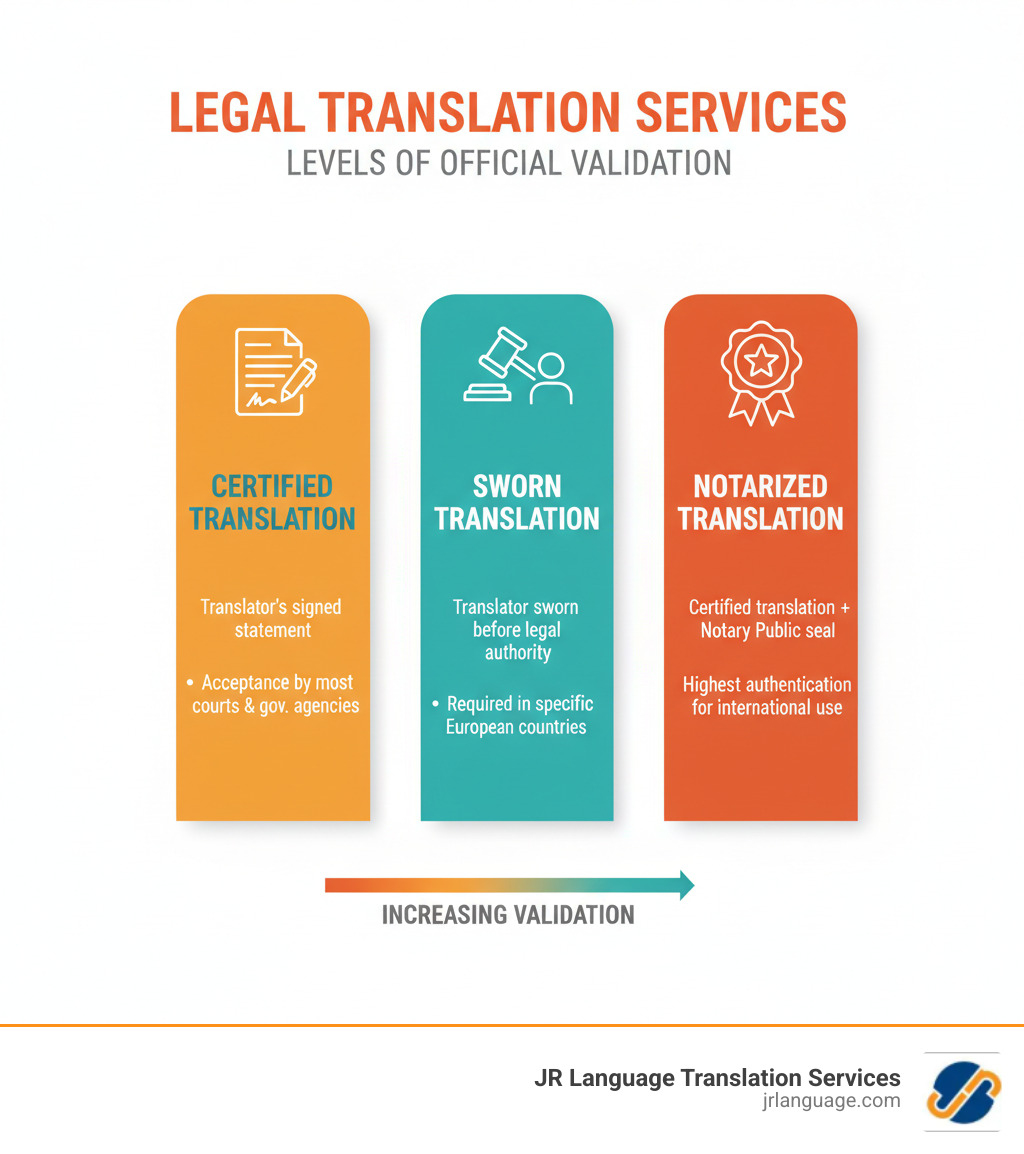
Different situations require different validation levels:
- Standard Translation: Professional, accurate translation for internal review, due diligence, or general understanding. No formal certification attached.
- Certified Translation: Includes a signed affidavit of accuracy from the translator or agency, widely accepted by courts and government agencies in the U.S., Canada, and the U.K.
- Sworn Translation: Performed by translators sworn before a legal authority—a requirement in civil law jurisdictions like France, Spain, and many Latin American countries. Their official stamp carries legal authority.
- Notarized Translation: Certified translation with an additional notary public seal, providing the highest authentication level often required for sensitive international filings.
Understanding which type your situation requires prevents rejected submissions, missed deadlines, and unnecessary expense.
Documents Requiring Legal Translation Services
Professional legal translation spans the full spectrum of international legal activity:
- Corporate and Commercial Documents: Sales agreements, partnership contracts, NDAs, terms of service, articles of incorporation, corporate bylaws, M&A due diligence reports, acquisition agreements, regulatory filings, employment contracts, and employee handbooks—the foundation of international commerce.
- Litigation and Dispute Resolution: Court transcripts, witness statements, depositions, discovery materials, legal briefs, arbitral awards, and court rulings. These documents demand perfect accuracy to become part of the legal record and withstand scrutiny.
- Intellectual Property: Patent applications combining legal and technical precision, trademark filings, licensing agreements, and IP protection documents where a single mistranslated term can jeopardize protection in entire markets.
- Personal Legal Documents: Birth certificates, marriage certificates, death certificates, wills, divorce decrees, visa applications, and educational transcripts—documents profoundly impacting individual lives, determining ability to immigrate, inherit, work, or study abroad.
Each document type carries specific legal requirements and consequences, demanding translators who understand both linguistic nuance and legal implications.
The High Stakes: Why Accuracy Matters
In legal translation, mistakes have real, measurable consequences. The risks aren’t theoretical—they’re documented in failed transactions, protracted disputes, and regulatory penalties.
Linguistic and Systemic Challenges
Legal terminology presents unique translation challenges. Many legal concepts lack direct equivalents between systems. The common law “trust” has no simple counterpart in civil law jurisdictions; translators must explain the concept, not just substitute words.
This complexity intensifies when bridging the common law (U.S., U.K., Commonwealth countries) and civil law (continental Europe, Latin America, Asia) systems, which operate on fundamentally different principles.
Cultural nuances further complicate legal translation. A grammatically perfect translation can fail if culturally tone-deaf, missing procedural expectations or communication norms that shape legal practice.
Concrete Consequences of Inaccuracy
Poor legal translation produces concrete, severe outcomes:
- Invalidated Agreements: Minor errors—mistranslated deadlines, misplaced decimals, misunderstood liability clauses—can render entire contracts unenforceable or expose companies to catastrophic risk.
- Financial Loss: Deals worth millions collapse over translation errors. Litigation costs skyrocket as parties dispute poorly translated terms. Regulatory penalties hit companies for non-compliant translations.
- Jeopardized Legal Strategy: Inaccurate translations of evidence or witness statements get challenged and discredited, undermining entire legal strategies. Opposing counsel exploits every error to cast doubt on your case.
- Operational Delays: Legal deadlines are absolute. Delayed translations mean missed filing deadlines, rejected court submissions, collapsed transactions, etc. In litigation, late or inaccurate translations of discovery documents can weaken cases or trigger sanctions.
Investing in quality legal translation services from the start isn’t an expense—it’s essential business protection.

Essential Qualities of Professional Legal Translation Services
Choosing a legal translation provider means finding a partner committed to excellence across three critical dimensions: expertise, security, and technology.
Key qualifications include:
- Legal and linguistic expertise: Many are practicing or former lawyers, or hold extensive legal training, enabling them to navigate complex terminology and legal concepts with authority
- Subject matter specialization: Patent translations need technical field expertise; banking contracts require financial regulation knowledge; immigration documents demand familiarity with administrative law
- Continuous professional development: Top translators stay current with evolving laws, regulations, and terminology across jurisdictions
Professional translation services match linguists with backgrounds in relevant fields, such as aviation, banking, life sciences, and technology, to specific projects, ensuring translations are not only linguistically accurate but also technically sound.
Ensuring Confidentiality and Data Security
Legal documents contain sensitive information. Data breaches can compromise legal strategy, violate client confidentiality, and trigger regulatory violations.
Robust security protocols include:
- Legal safeguards: Strict Non-Disclosure Agreements (NDAs) signed by every linguist and team member
- Technical protection: Secure client portals, end-to-end encryption for all document exchange, and systems designed to mitigate cyber risks
- Compliance certification: Adherence to GDPR and data privacy regulations, plus ISO 27001 certification demonstrating systematic information security management
Major financial institutions and government agencies trust providers with ISO 27001 certification because it demonstrates zero tolerance for security failure.
Technology Enhancing Human Expertise
While skilled translators remain irreplaceable, modern technology transforms efficiency, consistency, and cost-effectiveness.
- Translation Memory (TM): Databases storing previously translated sentences and phrases ensure perfect consistency across documents. When similar text appears, TM suggests approved translations—essential for maintaining consistency in terminology across extensive legal documentation.
- Terminology Management: Client-specific glossaries and style guides ensure specialized vocabulary usage remains consistent across all documents, eliminating ambiguity and reinforcing preferred legal terminology.
- Machine Translation with Post-Editing (MTPE): For high-volume projects, neural machine translation provides rapid first drafts carefully reviewed and corrected by human legal translators, balancing speed with accuracy for appropriate contexts.
Professional services integrate advanced technology with human expertise, optimizing legal strategy while maintaining the precision only experienced legal translators deliver.
Choosing Your Legal Translation Partner
Selecting a legal translation provider is a strategic decision protecting your business from legal mistakes and ensuring compliance. Ask the right questions to identify providers with capabilities for consistently excellent results.
JR Language: Your Partner for Global Legal Success
In today’s interconnected business environment, legal translation services aren’t just helpful—they’re essential for global success and risk mitigation. The consequences of poor translation are too severe to leave to chance.
Choosing the right professional translation services partner represents a strategic investment in legal protection, regulatory compliance, and smooth global operations. You need a partner who understands that legal translation preserves legal intent, not just converts words.
At JR Language Translation Services, we deliver culturally accurate translations through native, industry-experienced translators who understand both the letter and spirit of the law. Our team includes jurilinguists and subject matter experts with real-world legal experience across corporate law, intellectual property, litigation, and regulatory compliance.
We combine human expertise with multi-tier quality assurance, ISO-certified security protocols, and advanced translation technology, ensuring consistency, confidentiality, and precision. Whether you need certified translations for immigration proceedings, patent translations for IP protection, or comprehensive document translation for cross-border M&A transactions, our specialized legal translation services protect your interests at every turn.


