

A U.S. offer letter is built on at-will employment: short, informal, easy to change. Take it abroad, though, and it usually falls apart. Most countries require something far more binding – a detailed employment contract, in the local language, with statutory protections baked in. That’s exactly why you need multilingual translation services handled by professionals with real subject-matter expertise, not just two languages on a resume.
At JR Language Translation Services, this is one of the most common gaps we see: a company hires its first international employee, and nobody’s thought through what the contract needs to say in that employee’s language. Employment contract translation services close that gap. But closing it well takes more than swapping one word for another.
Why a U.S. Offer Letter Doesn’t Travel Well
When navigating legal contract translation requirements, you must be familiar not only with U.S. laws but also with global regulations. Almost nowhere else does the at-will doctrine that shapes U.S. hiring have a real equivalent.
- A U.S. offer letter can be short and informal, and it’s easy to change with barely any severance owed
- Most other countries run on statutory labor codes or collective bargaining agreements instead, and those require detailed, binding contracts
- Working hours, mandatory benefits, leave, disciplinary procedures, and statutory notice — these all must be spelled out in writing
- The EU sets a hard deadline for employers to hand over comprehensive written terms after hiring, and a boilerplate U.S. template won’t clear that bar
Reading clearly isn’t enough for a translated employment agreement. It must preserve the legal meaning, use the correct local labor terms, and follow the language and formatting rules of the place where your employee works.
Where Local Language Requirements Are Non-Negotiable
In several major markets, the local-language version isn’t a courtesy translation. It’s the only one that counts legally.
- In China, a written labor contract must be in Simplified Chinese. Miss the one-month window after the employee starts, and you could owe double wages for every month you’re out of compliance.
- France requires it too: any workplace document that imposes obligations on an employee must be in French, or a court simply won’t enforce it.
- Across much of Latin America, regional labor codes require the foundational workplace records to be in Portuguese or Spanish, with no exceptions.
And that requirement isn’t going away. If anything, it’s getting more relevant. 52% of executives say they plan to expand internationally within the next 18 months, and most of the companies surveyed report that shifting immigration and labor policies are already accelerating their hiring decisions. More international hires simply mean more contracts that must meet a language requirement that the U.S. version was never built to handle.
The Contract Clauses That Carry the Most Risk in Translation
At JR Language, we flag these four clauses first, because they’re where clients most often get burned, even when the sentence itself reads perfectly fine.
- Confidentiality and IP assignments are where a generic American IP clause won’t automatically assign an employee’s inventions to you in many civil law countries. Moral rights waivers and local copyright language must be spelled out explicitly, not assumed.
- Non-compete covenants are geographically capped in many European and Asian jurisdictions, and some require you to continue paying the employee during the restricted period just to keep the clause valid at all.
- Probationary periods run from three to six months in most countries, and they’re tightly regulated. Handle a dismissal wrong during that window, and you’re exposed.
- Termination and severance are the trickiest of all. Without at-will protection, you generally need documented just cause or a redundancy justification, plus a severance formula that must translate with zero room for error.
What Happens When the Translation Falls Short
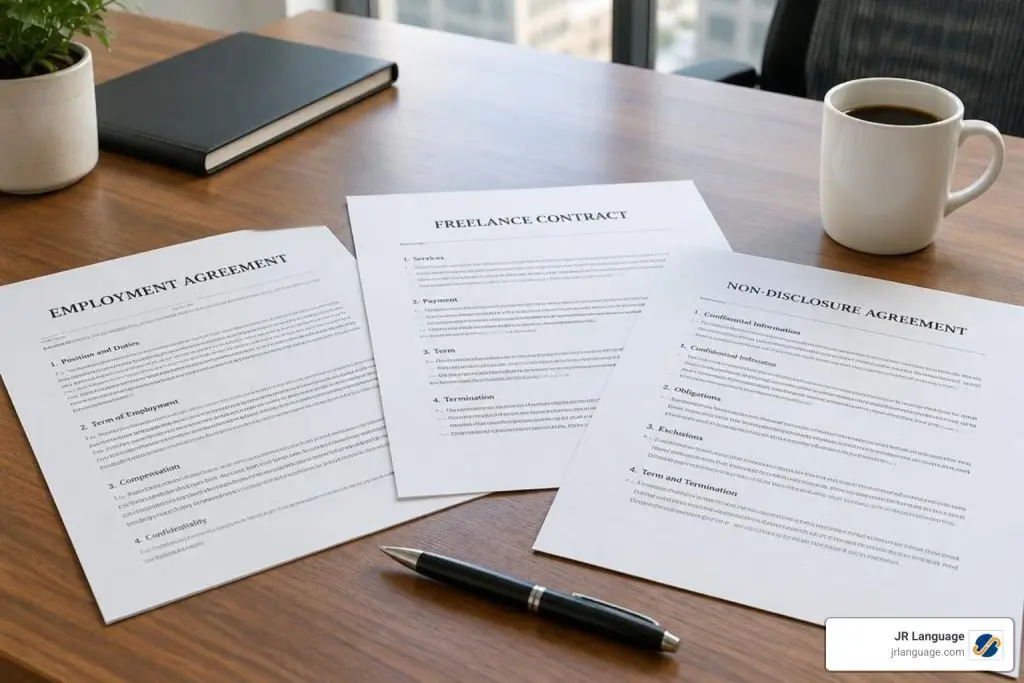
NDA, freelance, or full-time employee – no matter the type of contract translation, a mistranslated, generic employment contract can create real exposure to risks:
- Ambiguous terms leave plenty of room for employees and regulators to argue about what was agreed to
- A surprising number of constructive dismissal claims and labor tribunal disputes trace back to language that just wasn’t precise enough
- Visa and work-permit officers read job titles, duties, and pay figures closely — get one translation wrong, and the application can be rejected outright
- Machine translation tools and non-specialized freelancers miss exactly the legal terminology that makes a clause enforceable in the first place, more often than you’d think
Build Your International Hiring on Contracts That Hold Up
Hiring across borders shouldn’t be a gamble on whether your employment global contract translation protects you where it’s signed.
JR Language Translation Services works with legal translation service experts who understand comparative labor law, not just two languages, so your employment agreements are held up under the statutory framework of wherever you’re hiring.
Bringing on your first international employee? Standardizing contracts across a growing global team? Need a certified translation of your contract for legal purposes? Consult with us today, and our team will walk through exactly what your employment agreements need before you extend an offer.


