An employee handbook is only as good as the employees who can actually understand it.
Let’s say half your team speaks Spanish at home. Maybe a quarter speak Mandarin or Vietnamese. However, your handbook only exists in English. Then you don’t have a compliance document. You have a liability.
Here’s the reality: foreign-born workers make up almost 20% of the U.S. civilian labor force. For organizations with multilingual workforces, employee handbook translations aren’t an HR nicety. It’s a risk management necessity.
This is where professional translation services by a trusted translation company can help.

Why Employee Handbook Translation Matters More Than You Think
An employee handbook isn’t just an orientation packet. It’s a legal document. This defines expectations and outlines rights. It also establishes the protocols your employees are expected to follow from day one.
But what if your employees can’t read it? Or understand it in their primary language? The consequences are very real and very measurable.
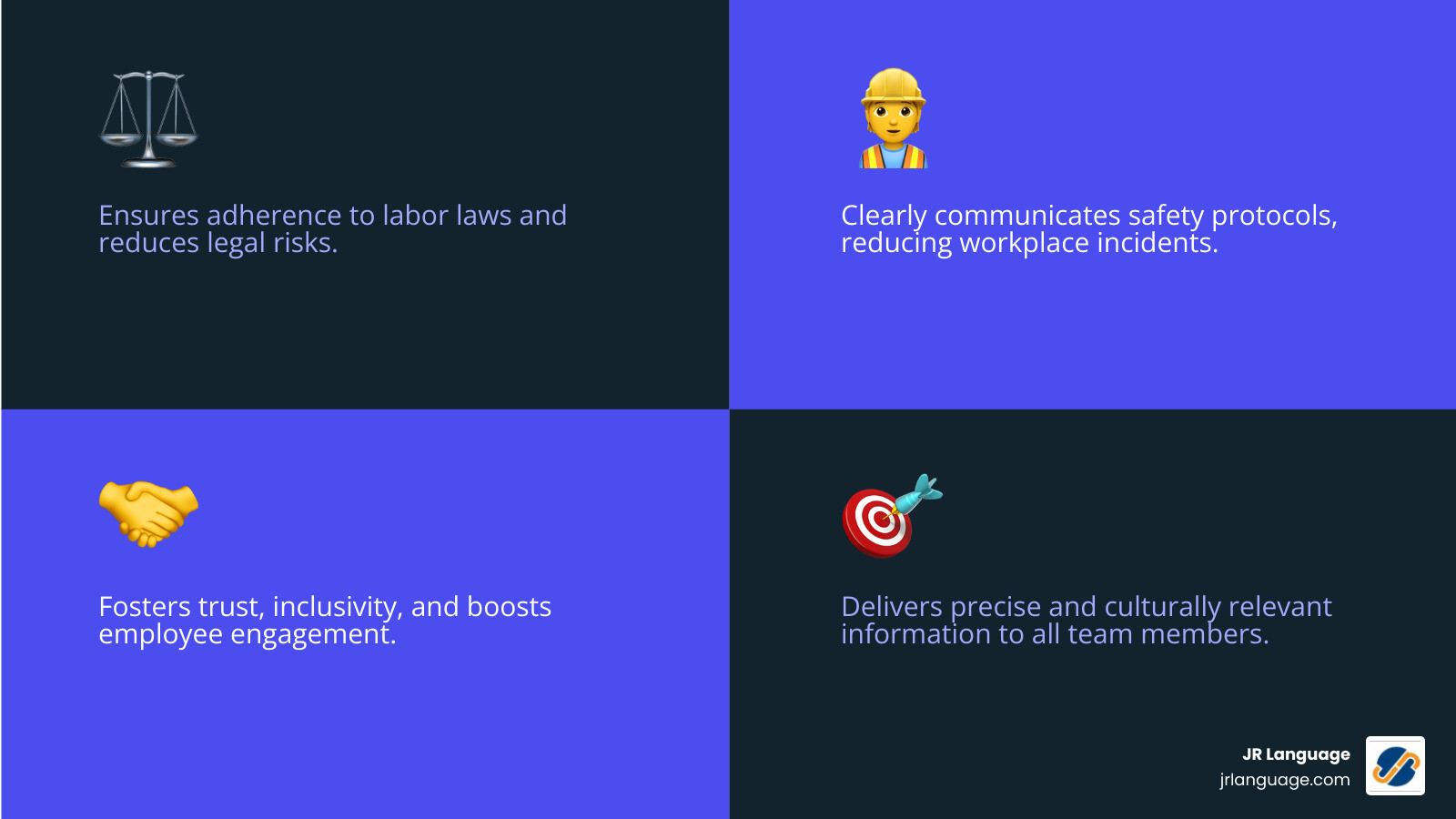
Legal Exposure Increases
Employers can face discrimination claims under Title VII when non-English-speaking employees don’t have meaningful access to workplace policies. The EEOC has specifically called out communication failures tied to national origin and language as sources of both legal and safety exposure.
Safety Incidents Become More Likely
Think about it this way: if a worker doesn’t fully understand emergency procedures or equipment safety protocols, risk climbs. This is especially true in manufacturing, construction, healthcare, and other high-stakes environments where a misunderstood instruction can mean a serious injury.
Turnover Climbs
Employees who don’t understand policies around benefits, leave, performance expectations, or workplace conduct are less engaged. They’re more likely to make compliance mistakes. And they’re more likely to leave. This costs you far more than an HR translation service project ever would.
Operational Friction Compounds
Small misunderstandings about schedules, overtime, disciplinary processes, or data security add up fast. Something started as a minor communication gap? It can quickly turn into productivity losses, management headaches, and cultural tension across teams.
A translated handbook isn’t just about inclusion, though that absolutely matters. Using multilingual translation services in the workplace is about making sure your diverse workforce can actually do what you’re asking them to do, safely and effectively.
HR Translation Services for Employee Handbooks: Define Your Scope
Before you reach out to a translation provider, take a step back. Get clear on what you’re translating and for whom.
Assess Your Workforce Language Needs
Start with the data you already have. HR records, employee surveys, and intake forms can tell you a lot about the primary languages spoken across your team. In most U.S. workplaces, Spanish is the most common non-English language. Your primary need may be for a Spanish employee handbook translation. Depending on your region and industry, you might also be looking at:
- Chinese (Mandarin and Cantonese)
- Vietnamese
- Tagalog
- French or Portuguese
- Hindi
Location Considerations
Do you operate across multiple states? Are you managing distributed teams? Then your needs may vary significantly by location.
A warehouse in Southern California might need to translate documents into Spanish and Vietnamese. A Bay Area tech company might prioritize Mandarin and Hindi.
The key is to know your audience before you set your scope.
Identify Every Document That Needs Translation
Your employee handbook is the anchor. But it’s rarely the only HR document that matters, and translating the handbook while leaving everything else in English creates confusion fast.
For a truly cohesive experience, consider also translating:
- Employment contracts and offer letters. This way, your employees know what they’re agreeing to from day one
- Onboarding materials and new hire packets
- Safety manuals, protocols, and OSHA-required postings
- Benefits enrollment guides and open enrollment materials
- Performance evaluation forms and processes
- Training materials and compliance certifications
- Workplace conduct policies. These would cover harassment, discrimination, data security, and more
- Leave policies: FMLA, sick leave, parental leave
Are you only translating the handbook? But leaving safety manuals or benefits forms untouched? Then that would undermine the whole effort. Think of it holistically.
What to Look for in an HR Translation Partner
When you’re evaluating providers, here are the capabilities that matter most:
Native-speaking translators with HR and legal expertise
A good provider should be able to tell you exactly who is working on your project and confirm that the linguist has experience with employment documentation.
A multi-step quality assurance process
Professional workflows include translation by a subject matter expert, editing by a second linguist, and a final proofreading pass for consistency and accuracy. This three-step review is standard in professional translation services.
Confidentiality and data security protocols
Your employee handbook contains sensitive information. Your provider should operate under strict NDAs and use secure file transfer systems.
Dedicated project management
A great provider gives you a single point of contact: a project manager who coordinates workflow, answers your questions, and keeps everything on schedule. No rotating cast of vendors. No chasing down updates.
At JR Language, we adhere to rigorous translation quality standards and are proud members of the American Translators Association. We have decades of experience working with organizations with multilingual workforces across industries.

Your Workforce Deserves to Understand the Rules
Translating your employee handbook is more than compliance. No matter what language they speak at home, all of your employees deserve full access to the policies, protections, and expectations that govern their work.
That’s not just good HR practice. It’s the foundation of a functional, fair workplace.
Employee Handbook Translation Services and More: We Are Happy to Help!
At JR Language Translation Services, we specialize in multilingual business documentation translations for organizations with diverse workforces. We work with native-speaking subject-matter expert translators. Together, we deliver accurate, culturally appropriate, and legally sound translations across more than 100 languages.
Ready to get started? Request a free quote today – and let’s make sure your entire team can actually read the handbook.