Last year, a single mistranslation on an immigration form delayed a family’s reunion by 8 months. A misinterpreted clause in a business contract cost a mid-sized company tens of thousands of dollars in dispute resolution costs. A medical record translation error nearly resulted in a patient receiving the wrong medication dosage.
These aren’t hypotheticals. They’re the real, documented consequences of what happens when document translation goes wrong.
Work With Professional Translators for Your Official Documents
When you’re submitting immigration paperwork, finalizing international contracts, or translating medical records, “close enough” genuinely isn’t close enough. You need professional translation services that deliver precision, cultural accuracy, and official certification. The documents that matter most don’t get second chances.
Birth certificates for citizenship applications. Contracts for cross-border deals. Diplomas for credential evaluation. Get it wrong, and you’re not just starting over yourself. You’re paying for it.
That’s where accurate document translation stops being a service and starts being the difference between acceptance and rejection, between clarity and costly confusion.

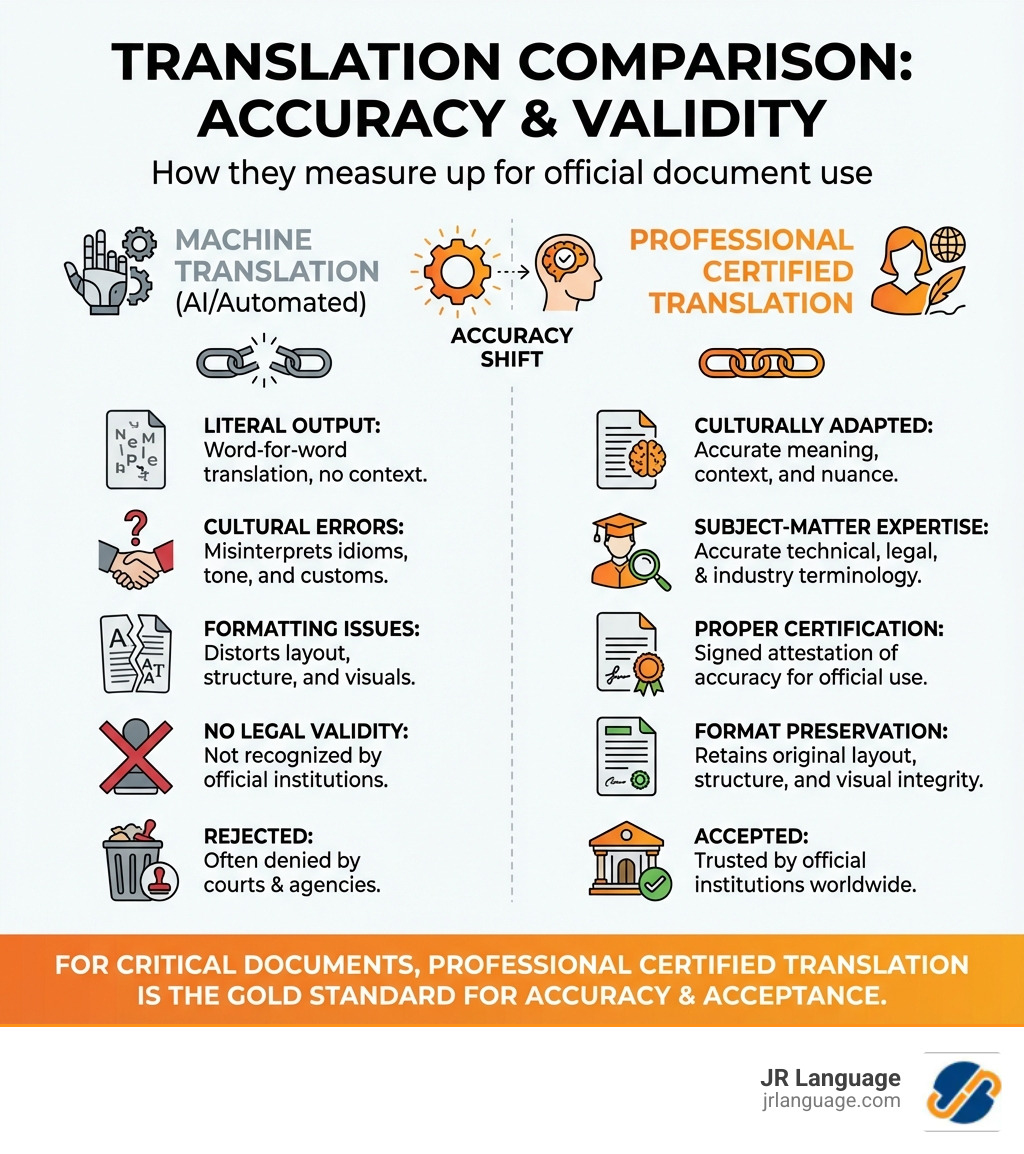
What “Accurate” Actually Means—And Why Machine Translation Doesn’t Get There
True translation accuracy isn’t just about swapping words between languages. It’s about producing a document that actually works in the real world, for its intended purpose, in front of the institution that needs to accept it.
That requires a few things working together.
- Linguistic precision means capturing the original meaning and intent completely—not just the words, but the context, the idioms, and the nuance that exists in both languages simultaneously.
- Cultural appropriateness ensures the translation feels natural to its audience. A grammatically perfect sentence can still fail if it ignores local customs or sounds strange to a native speaker reading it for the first time.
- Contextual relevance requires translators to understand what a document is actually for. Legal terms in a contract need to be handled entirely differently from the same words in a technical manual.
- Format integrity is especially critical for official documents, where seals, signatures, tables, and layout often need to be precisely replicated to maintain authenticity in the eyes of the receiving institution.
Why Free Tools Fall Short
Free online translation tools miss all of the above. They treat your birth certificate like a grocery list and your contract like a blog post. They can’t provide legal certification. They can’t protect confidential information. And they definitely can’t explain to USCIS why your translation doesn’t align with their formatting requirements.
That explanation falls on you — after the rejection.
Certified vs. Notarized: Understanding What Official Bodies Actually Want
If you’re preparing documents for government agencies, universities, or courts, you’ll run into two terms: “certified translation” and “notarized translation.” They sound similar. They’re not interchangeable.
What Is a Certified Translation?
A certified translation includes a signed statement from the translator or agency confirming that the translation is accurate and complete. This Certificate of Accuracy attests to the translator’s qualifications and their responsibility for the work.
Most institutions—including USCIS and major universities—accept certified translations as standard.
What Is a Notarized Translation?
Notarization adds one additional step: a notary public verifies the identity of the person signing the Certificate of Accuracy. Importantly, the notary doesn’t evaluate the translation itself—they simply confirm that the signature is legitimate. Some jurisdictions or specific institutions require this extra layer, and we can arrange it when your situation calls for it.
The Hidden Costs of Getting It Wrong
Translation errors don’t just cause inconvenience. For individuals navigating immigration, credential evaluation, or international relocation, a single mistake can trigger a cascade of problems:
- Immigration delays: Wrong dates, misspelled names, or incomplete translations trigger requests for resubmission—adding months to processing timelines that were already stressful
- Rejected applications: Some errors result in outright denials, requiring expensive reapplications and restarting the clock entirely
- Financial losses: Business contracts with ambiguous translations can lead to disputes, penalties, or broken partnerships—often far more expensive than the translation itself would have cost
- Safety risks: Medical translation errors can directly affect treatment decisions and patient outcomes. This is the category where mistakes have the most serious consequences of all
Document translation isn’t a place to cut corners or shop for the lowest bid. The downstream costs almost always dwarf whatever you saved up front.
The Documents That Need Special Handling
Not all documents are created equal, and the type of document determines the expertise required.
Legal Documents
Contracts, court filings, patents, and compliance materials require translators who understand legal systems and jurisdictional nuances—not just the language. A mistranslated clause isn’t just awkward; it can invalidate an agreement or trigger a dispute that costs significantly more to resolve than the contract was worth.
Medical Records
Clinical trial documentation, patient records, and pharmaceutical materials need to meet regulatory standards and protect patient safety above all else. Translation errors in this category aren’t embarrassing—they’re dangerous. Full stop.
Technical Manuals
Equipment specifications, software documentation, and manufacturing instructions require precision and clarity at every step. Think about what incorrect translations can cause. You may have equipment damage. You can create safety hazards. Or you can introduce costly errors into production workflows.
Personal Documents
Birth certificates, marriage certificates, academic transcripts, diplomas, and police clearances all require exact matching. The names, dates, reference numbers, and official seals must mirror the originals precisely. Even small discrepancies raise questions and cause delays. Institutions notice, and they follow up.
Your Next Step: Getting It Right the First Time
Official translation services for your documents aren’t about perfection for perfection’s sake. It’s about making sure your most important transactions, applications, and agreements move forward. You will avoid delays, rejections, or mistakes that cost far more to fix than they would have to prevent.
At JR Language, we handle translations across legal, medical, technical, and personal documents with the same commitment to quality: native-speaking translators with subject-matter expertise, multi-layer quality control, and proper certification that meets institutional requirements across the board.
Reach Out to Our Professional Translators For All Your Official Document Translations
Whether you’re submitting immigration paperwork to USCIS in Texas, translating contracts for international business, or preparing credential evaluations for professional licensing, we deliver translations that work the first time.
Ready to move forward? Request a free quote for your translation project and ensure your documents meet the required standards.