A manufacturing company in Ohio finalizes a supplier agreement with a firm in South Korea. The contract runs forty pages. Both parties need it in their own language, with identical legal force on both sides.
Across town, a family originally from Guatemala is completing a green card application. They need three years of personal records translated and certified before their appointment. These could be birth certificates, marriage documents, and court records. The stakes in both cases are significant.
Different Documents, Same High Standards
The documents are completely different. But the professional translation service standard for both is the same.
This is the range that expert document translation services cover. At JR Language, we offer everything from high-volume corporate legal documentation to the single most important personal document a family has ever needed to be translated.
What holds it all together is a process built for accuracy, consistency, and accountability. Understanding that process helps any buyer make better decisions about choosing the right translation agency and following best practices.

Why Document Translation Demand Continues to Grow
The volume of documents moving between languages globally has grown steadily alongside international trade, immigration, and digital commerce. Legal document translation is the single largest category within multilingual translation services for all document types. The need is driven by cross-border business transactions, international litigation, and regulatory compliance requirements across jurisdictions.
That growth reflects a straightforward reality. More organizations are operating across more languages than ever before. The documentation that accompanies those operations ranges from contracts, compliance filings, employment records, technical specifications, and regulatory submissions.
All has to work in every language the organization touches.
Practical Implications for Document Translations: Why You Need Professional Translators
When Your Document Changes Language
Exploring the different types of professional document translation? First, it’s worth addressing something most buyers don’t know until they encounter it:
Translating a document doesn’t just change the words. It often changes the physical space those words occupy. This has real consequences for formatted documents.
The Layout Considerations
This phenomenon is called text expansion and contraction. It is one of the reasons professional document translation includes desktop publishing services.
The layout work is as important as linguistics.
Languages that expand English text: Spanish and French typically expand English source text by 20-30%. A one-page English contract summary becomes a page and a third in Spanish. A carefully formatted one-page marketing document becomes two pages, disrupting any page numbering, cross-references, or design elements that assumed a specific layout.
German expands English by 30-35%, which is why German-language software interfaces often look compressed. Designers have to work backward from the longer text to fit the same screen space. Finnish and Hungarian can expand English text by up to 60% in some contexts.
Languages that compress English text: Chinese and Japanese, by contrast, typically compress it significantly, sometimes by 30-40%. A document that runs five pages in English might run three in Mandarin.
This sounds like an advantage, but it creates its own formatting challenges: charts and tables designed around longer text strings may have excessive white space, and the character density of these scripts affects line spacing, font size choices, and overall readability.
Why This Matters for Official Documents
For formatted legal documents, court submissions, and regulatory filings, layout matters as much as content. A certified translation that changes a document from one page to two may break internal references to page numbers or sections.
A translated contract exhibit that expands beyond its original bounds may need to be restructured to maintain the legal integrity of the original. Professional document translation services include desktop publishing expertise to address these formatting issues, not just linguistic conversion.
What Professional Document Translation Actually Involves
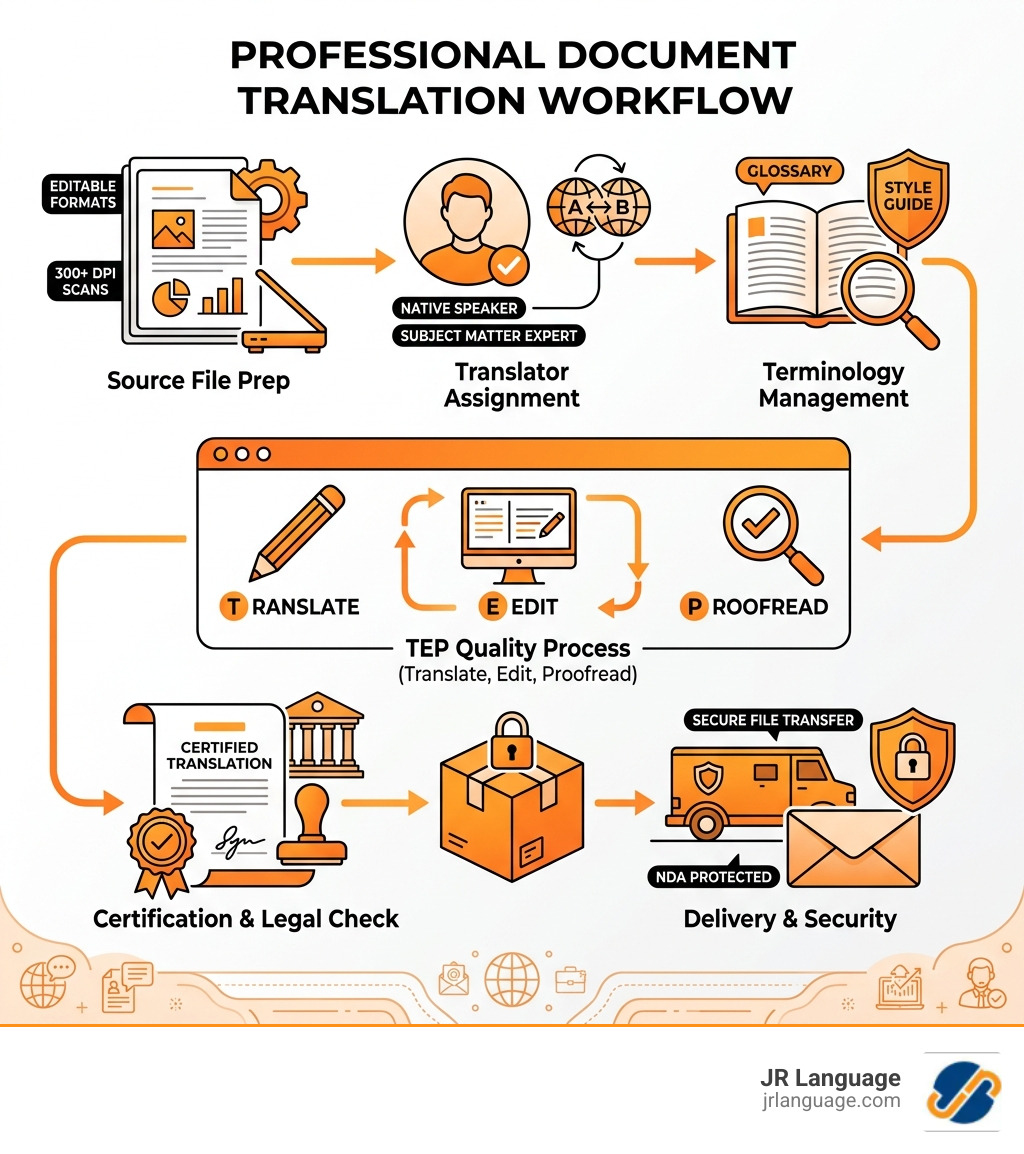
Qualified, Subject-Matter Matched Translators
The foundation of professional document translation is native-speaking translators with expertise in the relevant field. Language proficiency is the baseline, not the differentiator. A native Spanish speaker with a background in commercial law is the right translator for a contract. A native Japanese speaker with pharmaceutical knowledge is the right translator for a drug approval filing.
Mismatching translator expertise to document type is one of the most common quality failures in the industry and one of the most avoidable.
Terminology Management
For any organization with ongoing translation needs across multiple documents or projects, terminology management is what maintains consistency over time. A glossary defines how key terms, brand names, product names, and technical concepts should be rendered in each target language so that a term established in a contract appears the same way in a compliance filing, a training document, and a marketing piece.
Without it, the same concept can be translated differently across documents, which creates confusion and, in legal contexts, potential ambiguity.
The TEP Quality Process
Professional document translation services follow a three-stage quality process: Translation, Editing, and Proofreading. Each stage is performed by a different qualified linguist.
- The translator produces the initial draft, working from the source document with full attention to meaning, tone, and subject-matter accuracy.
- The editor reviews the translated text against the source document, checking for accuracy, completeness, and natural flow in the target language, catching errors the translator may have missed and ensuring no nuance was lost.
- The proofreader performs a final pass for grammar, punctuation, formatting, and consistency. This stage catches errors that survive the editorial review, which are more common in long or complex documents than most buyers expect.
Handling the Details That Determine Acceptance
Official document translation has a set of professional conventions that determine whether a translated document will be accepted by institutions, and many non-professional translators get that wrong:
- Signatures, stamps, and seals are never reproduced. They are described in brackets: [signature] or [official seal of the Ministry of Interior].
- Dates are adapted to the target region’s standard format. The same date written as 05/06/2026 means May 6th in the U.S. and June 5th in the UK.
- Illegible handwriting is marked as [illegible] — never guessed at.
- Typographical errors in the source document are translated as written, with [sic] notation to indicate the error was in the original.
- Names are generally not translated but may be transliterated for pronunciation purposes.
These conventions are what make a translation “defensible” in a legal or regulatory context. Missing any of them can trigger a request for correction or an outright rejection.
Work With a Document Translation Provider Built for the Work
At JR Language Translation Services, our document translation services cover the full range. We work with corporate legal agreements and technical documentation, as well as certified personal records for immigration and court filings. We handle confidential document translations with the sensitivity and security they deserve.
Our translators are native speakers matched by subject-matter expertise to every project, and every document goes through our full TEP quality process before delivery. Certified translations are delivered with a properly formatted Certificate of Accuracy that meets USCIS, court, and institutional standards.
Reach Out to Us Today!
Managing ongoing multilingual documentation for a global organization? Need a single document translated and certified accurately and quickly?
For all of your needs, our team is ready to handle it with the professional standard the work demands. Contact our team today to discuss your project.