

A Seattle-based home goods retailer wanted to expand into Latin America. The opportunity was there, but the content challenge was massive.
They had 50,000 product listings to translate into Spanish and Portuguese, including product descriptions, technical specifications, care instructions, and SEO metadata. A human-only approach would have taken too long and cost too much. A machine-only approach would have been faster, but the results likely would have felt flat or awkward.
Professional translation services offer both raw AI translation and hybrid approaches—what to use often depends on the project.
AI + Humans: The Hybrid Approach
The company in the above example used AI for the first pass, then brought in native-speaking translators to review key categories, refine the tone, and ensure the content felt natural in each market.
That mix helped them move quickly without sacrificing quality where it mattered most. They launched in three Latin American markets within 90 days and maintained conversion rates in line with those on their English-language site.
Why this matters now
Multilingual translations are no longer just an operational task sitting quietly in the background. For many businesses, it is directly tied to growth.
If you are expanding into new markets, publishing more content, or trying to support multilingual audiences, business document translations can either help you scale or slow you down.
Content volume is growing fast
Most businesses are producing far more content than they were a few years ago. Website pages, product descriptions, support content, internal documentation, email campaigns, and video scripts all add up fast.
That is a big reason companies are turning to AI-powered or machine translation services. They need more speed, but they still need quality, too.

AI Translation Services Have Evolved
A lot of people still picture machine translation as robotic, literal, and clumsy. That reputation did not come out of nowhere.
Older systems often translated word by word, which made the output feel stiff and easy to spot.
Today’s tools are more advanced
Modern AI translation systems are much better at handling context. Instead of processing each word in isolation, they are better at looking at full sentences and producing language that sounds more natural.
That does not mean they are flawless. It just means they are much more useful than they used to be.
The output sounds smoother now
Large language models have also improved fluency. In many cases, the translated content reads more smoothly and less mechanically than older machine translation tools ever could.
That is part of why businesses are taking AI translation more seriously now.
Translation memory makes a big difference
One of the most useful tools in translation today is translation memory. It stores previously approved translations and reuses them when the same or similar phrasing appears again.
That helps with consistency, especially when companies have large websites, product catalogs, or repeated technical language.
Consistency matters more than people think
If a product name, feature, or technical phrase appears across dozens of pages, it should not be translated three different ways. Translation memory helps prevent that.
It also reduces repeated effort, which can save time and money over the long run.
Glossaries give AI more direction
AI translation works better when it has guidance. That is where glossaries and prompts come in.
Businesses can define preferred terminology, brand language, and regional phrasing so the output is more aligned with how they actually want to sound.
This is especially useful for branded content
If your company has a distinct tone or uses industry-specific language, you do not want the AI guessing. You want guardrails.
That kind of control can make AI translation much more practical in a professional workflow.
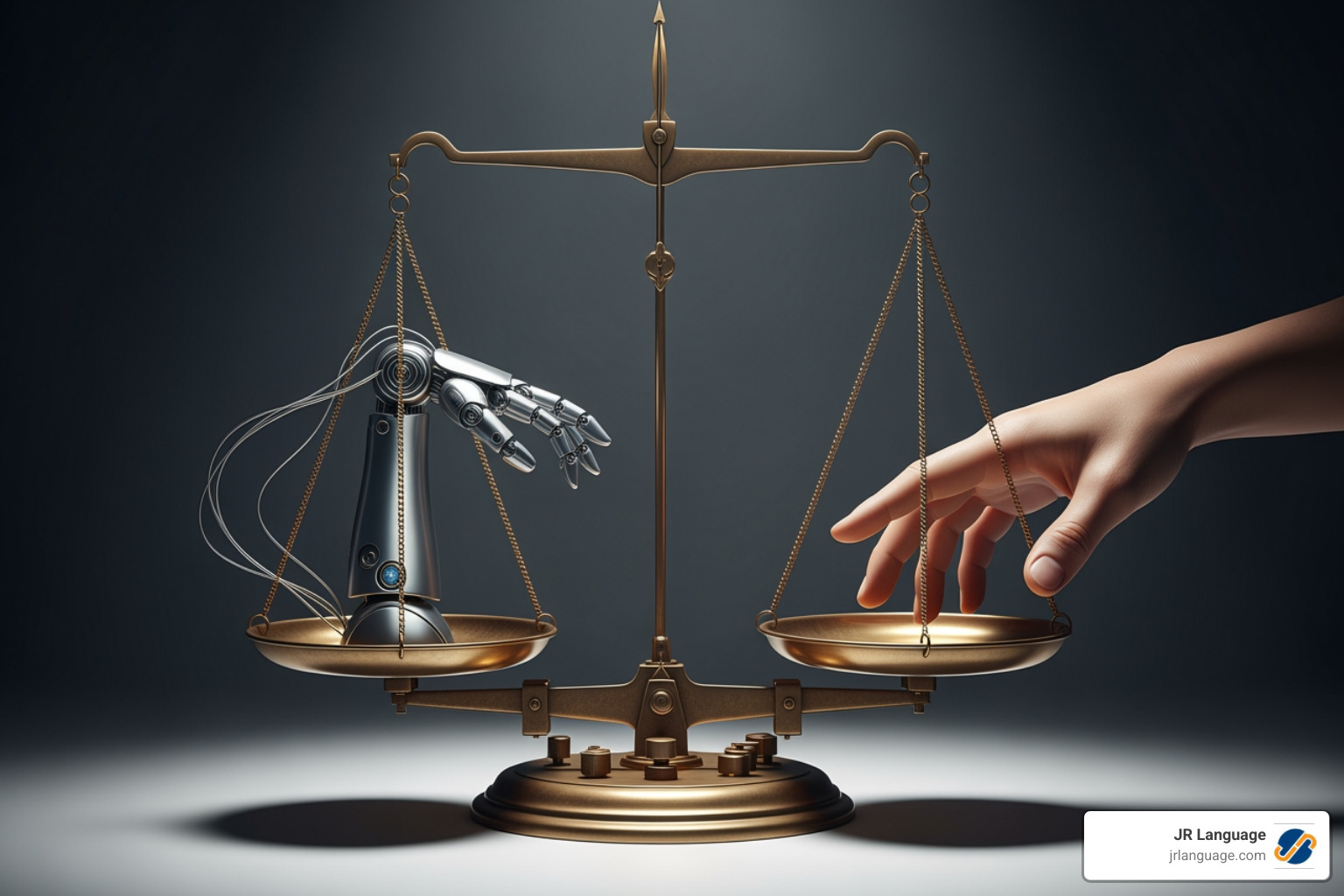
The real question is not AI or humans
That framing sounds dramatic, but it is not especially helpful.
For most businesses, the better question is this: what kind of translation workflow gives you the right balance of speed, quality, and cost?
Where AI works especially well
AI translation tends to work best when the content is high in volume, fairly structured, and not heavily dependent on tone or emotional nuance.
That is where it can save real time.
High-volume content is a strong fit
Product catalogs, internal documentation, technical specifications, and routine knowledge base content are often good candidates for AI-supported translation.
These kinds of materials usually follow repeatable patterns, which makes them easier for AI to handle efficiently.
Internal content can often move faster
For internal updates or lower-stakes communications, the goal is often a clear understanding rather than polished language.
In those cases, AI can be a very practical solution.
AI is useful for first drafts
Another strong use case is first-pass translation. AI can generate a draft quickly, then a human translator can step in to revise and improve it.
That can dramatically reduce turnaround time without leaving the final quality to automation alone.
The hybrid model often makes the most sense
For many organizations, the best strategy is a layered one.
That means using AI where it creates efficiency and using human translators where nuance, risk, or brand voice matter more.
Post-edited machine translation is a practical middle ground
In a hybrid workflow, AI produces the initial draft and human linguists edit it afterward. This approach is often called post-edited machine translation, or PEMT.
It gives teams a way to move faster while still making room for quality control and human judgment.
Not every content type needs the same level of review
A company does not need to translate every document the exact same way. Some content can move through a lighter workflow, while other content deserves closer human attention.
That kind of tiered model is usually more realistic and more cost-effective than trying to force one method onto everything.
What to look for in an AI translation solution
Not all AI translation tools are equally useful. Some save time. Others create more cleanup work than they are worth.
That is why the details matter.
Look for translation memory and glossary support
These features help keep language consistent across projects. Without them, even decent translation output can become messy over time.
Consistency is one of the main things that separates a workable workflow from a frustrating one.
Make sure it fits your workflow
A translation solution should work with the tools your team already uses. API access, CMS compatibility, and easy handoff to reviewers all matter.
If the process is awkward, it slows down adoption and creates extra friction.
Security deserves attention
If your business is translating customer-facing, proprietary, or regulated content, security cannot be an afterthought.
You need to know how files are handled, whether data is protected, and whether content is being used to train public models.
Human review should be easy to add
Even if you want AI to do a lot of the early work, you still want the option to bring in human oversight when needed.
That flexibility matters. Not every piece of content has the same stakes.
Cost savings are not just about price per word
When people talk about AI translation, they often focus only on the lower translation cost.
That is part of the story, but not the full one.
Efficiency creates bigger savings
AI can speed up first-pass translation, reduce manual work, and help teams publish faster. Translation memory also cuts down on repeated effort over time.
That kind of efficiency has real business value, especially when content timelines affect market entry or revenue.
Faster launches can create business value
If a better translation workflow helps you launch in a new market weeks or months sooner, the upside goes beyond the translation budget itself.
That is one reason businesses are looking at this more strategically now.
Build a translation strategy that fits the content
AI translation has made multilingual communication faster and more scalable. That is real.
But the smartest companies are not using AI blindly. They are using it selectively and pairing it with human expertise where quality, trust, and nuance matter more.
The strongest strategy is usually balanced
Use AI where it improves efficiency. Use human translators where the stakes are higher.
That kind of approach is often much more effective than treating every document the same way.
The goal is not about choosing sides
This is not really about humans versus machines. It is about creating a workflow that fits the actual content and supports business goals.
When that balance is right, translation becomes much more than a support function.
Scale your global content with a smarter translation strategy
If your content is growing, your translation process needs to grow with it.
That may mean using AI for first drafts, human translators for high-stakes messaging, and a hybrid system for everything in between. JR Language Translation Services supports that kind of flexible approach, combining AI-powered efficiency with professional human oversight to help businesses scale multilingual content more effectively.
When the workflow is built well, translation stops being a bottleneck and starts becoming a real advantage.


