anDearborn, Michigan, is 54.5% Arab American – the first US city to ever have a majority of its population identified as having Arab ancestry on the Census. You can trace the influx back to the broader Southeast Michigan region to the 1920s, when Lebanese, Yemeni, and Syrian workers were drawn to Henry Ford’s factory on the Rouge River.
That original wave of immigration built something remarkable: a multigenerational Arab American community that is now woven into the fabric of Michigan’s economy, civic life, culture, and institutions at every level. Business owners, physicians, elected officials, educators, and engineers — the Arab American community in Michigan participates fully in the state’s public and professional life.
What Certified Translation Services Mean for this Community
That depth of integration also generates one of the most sustained and diverse demands for certified Arabic translation services anywhere in the United States. Not because the community is foreign — most are American-born or long-established residents — but because life in America creates a need for Arabic translations of English-language materials.
A century of family history in the Arab world also means records, vital documents, and official paperwork in Arabic often need to be translated back into English.
Professional translation services that understand both the language and the community are what make those crossings work. At JR Language, our Michigan translation services provide language solutions to this community – as well as to businesses catering to Arab Americans – in a variety of ways.
Arabic Dialects in Michigan: Why It Matters
One of the biggest challenges in Arabic translation in Michigan is that Arabic isn’t a one-size-fits-all language. There are distinct regional varieties – Modern Standard Arabic (MSA) is only one part of the picture. It is the formal written standard used in government documents, legal filings, and formal correspondence across the Arab world.
On the other hand, the Arabic spoken and written in personal documents, letters, family records, and informal correspondence can vary significantly by country of origin.
Michigan’s Arab American community spans several distinct regional varieties:
- Lebanese Arabic: This is the dialect of Michigan’s oldest established Arab American community, with specific vocabulary and phrasing that differ meaningfully from other regional varieties.
- Yemeni Arabic: It is spoken by the largest recent immigrant group in Michigan. It has distinct features that require a translator specifically familiar with Yemeni linguistic conventions.
- Iraqi Arabic: Michigan has a significant Iraqi American community who speak this dialect. It comes with its own regional characteristics.
- Palestinian Arabic: It has features that reflect the specific regional origin of Palestinian families in the community
When it comes to Arabic document translation, you can’t just translate MSA into English – you need a translator with the skills and knowledge to capture the nuances and subtleties of the different dialects. For certified translation purposes, such as translating Arabic birth certificates, this precision matters.
What Certified Arabic Translation Services Cover in Michigan
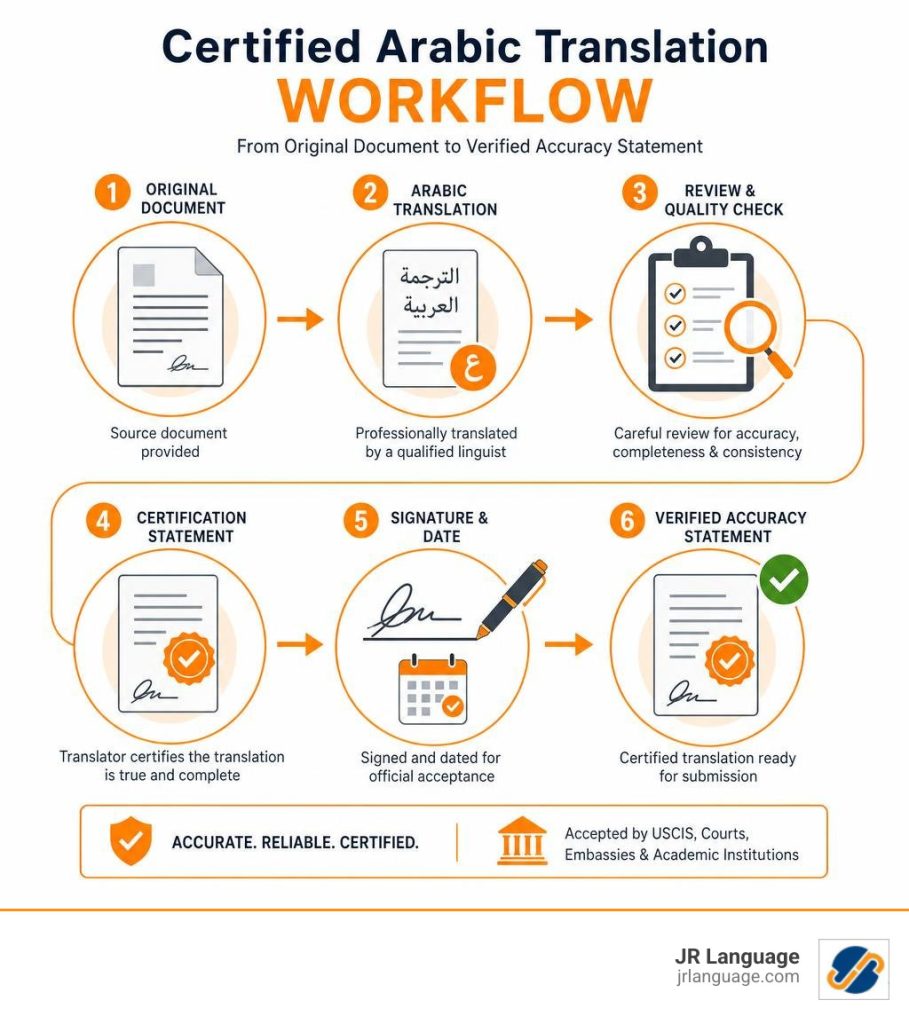
Professional certified translation services are required when an Arabic language document must be submitted to a US government agency, court, academic institution, or professional licensing board.
In Michigan, that covers an enormous volume of activity given the size and diversity of the Arab American community.
Immigration and USCIS Documents
For Michigan’s Arab American community, immigration document translation is both a first-generation need and an ongoing one as family members sponsor relatives, seek naturalization, or navigate status adjustments. Certified translations for USCIS apply to all foreign language documents, with no exceptions.
The most often needed include:
- Arabic birth certificate translations – required for virtually every immigration filing involving the applicant or their family members; Arabic birth certificates have specific formatting and notation conventions that must be rendered correctly
- Marriage and divorce certificates – needed for spousal petitions, family reunification applications, and status adjustments
- Police clearance records and court documents – in demand for admissibility determinations and background documentation
- Passports and national identity documents – required when these are submitted as supporting immigration evidence
The certification format matters as much as the translation itself. USCIS has specific requirements for how the certificate of accuracy must be presented. An official translation that is accurate but incorrectly formatted can trigger a Request for Evidence, delaying an entire application.
Family Court and Legal Documents
Michigan courts handle a significant amount of legal proceedings involving Arabic-speaking parties, leading to a high demand for our Detroit translation services for legal documents.
Family court matters, custody agreements, property disputes, estate proceedings, and civil litigation all generate Arabic-language documents that need certified translation for court admissibility. This includes:
- Custody agreements and family court orders
- Property deeds and inheritance documentation
- Wills and estate records
- Contracts and legal correspondence involving parties in Arabic-speaking countries
- Witness statements and affidavits
Arabic legal document translation needs translators who understand both the language and the legal conventions of the US system and the originating country, as concepts are expressed differently in the US system, which a general Arabic translator might miss.
JR Language: Certified Translations for Michigan’s Arab-American Families
At JR Language Translation Services, we work with Arab-American individuals and families across Southeast Michigan — in Dearborn, Detroit, Dearborn Heights, Sterling Heights, and the broader metro area — navigating the full range of certified Arabic translation needs that come with building a life in both languages.
Our Arabic translators bring native fluency in the dialects most common in Michigan’s Arab American community, combined with expertise in translating immigration, legal, medical, and academic documents. Every certified translation includes a properly formatted certificate of accuracy that meets USCIS, Michigan court, and university requirements — and our translations have a 100% acceptance rate for immigration filings.
Whether you need an Arabic birth certificate translation for a USCIS filing, court documents certified for a Michigan family court proceeding, or academic credentials translated for a professional licensing board, we deliver with the accuracy, dialect precision, and confidentiality that Michigan’s Arab American community deserves.